
- India
- May 11
- Sreesha V.M
DRDO conducts flight-trial of MIRV system
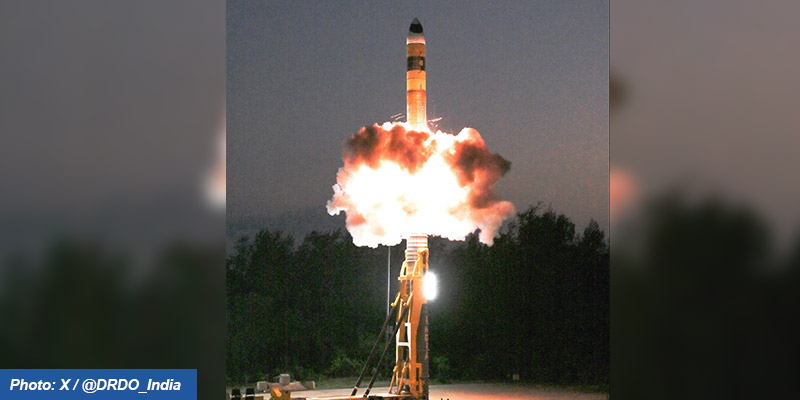
• The Defence Research and Development Organisation (DRDO) successfully conducted a flight-trial of an Advanced Agni missile with Multiple Independently Targeted Re-Entry Vehicle (MIRV) system from A.P.J. Abdul Kalam Island, Odisha on May 8.
• The missile was flight-tested with multiple payloads, targeted to different targets spatially distributed over a large geographical area in the Indian Ocean Region.
• The telemetry and tracking was carried out by multiple ground and ship-based stations.
• These systems tracked the entire missile trajectory from lift-off till the impact of all payloads.
• Flight data confirmed that all mission objectives were met during the trial.
• With this successful trial, India once again demonstrated the capability to target multiple strategic targets using a single missile system.
• This missile is developed by DRDO laboratories with the support of industries across the country.
MIRV technology
• According to The Centre for Arms Control and Non-Proliferation, Multiple Independently Targetable Re-entry Vehicles (MIRV) technology was originally developed in the early 1960s.
• It was developed to allow a single missile to carry multiple nuclear warheads, each capable of striking different targets independently, unlike traditional missiles.
• Warheads on missiles with this technology can be released from the missile at different speeds and in different directions.
• The development of MIRV technology is not easy. It requires the combination of large missiles, small warheads, accurate guidance, and a complex mechanism for releasing warheads sequentially during flight.
(The author is a trainer for Civil Services aspirants.)