
- India
- May 12
President Murmu confers National Florence Nightingale Awards to 15 nurses
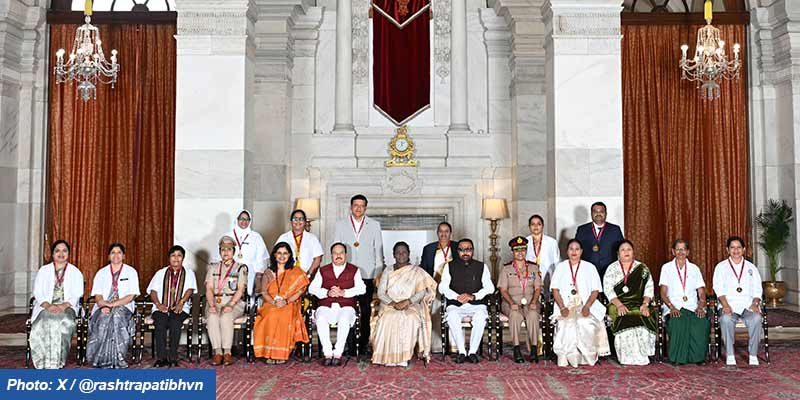
• President Droupadi Murmu conferred the National Florence Nightingale Awards for the year 2026 to nursing professionals at a ceremony held at Rashtrapati Bhavan on May 12.
• A total of 15 nurses from diverse regions and healthcare settings were honoured in recognition of their exemplary service, unwavering dedication to strengthening public health delivery, and outstanding commitment to the welfare of the community.
• Each awardee received a certificate of merit, cash reward of Rs 1 lakh and a medal.
• The awards were presented on International Nurses Day. It commemorates the birth anniversary of Florence Nightingale.
• The National Florence Nightingale Award was instituted in 1973 by the Ministry of Health and Family Welfare to honour outstanding nursing personnel in various settings.
• The awards are presented to registered nurses, midwives, auxiliary nurse midwives, and lady health visitors serving across central and state governments, Union Territories, and voluntary organisations.
Who was Florence Nightingale?
• Florence Nightingale (1820-1910) was a British nurse, social reformer and statistician. She was the founder of modern nursing. She was born in Italy and named after the city of her birth.
• As she grew up, she decided that she wanted to help the sick and injured, and wanted to become a nurse.
• Her father gave his permission for her to go to Germany to train in 1844 in a hospital in Kaiserwerth. When she returned she became the superintendent of a hospital for gentlewomen in Harley Street, London.
• Britain was at war with Russia in a conflict called the Crimean War (1854-1856). The army base hospital at Scutari in Constantinople was unclean, poorly supplied with bandages and soap and the patients did not have proper food or medicine.
• In November 1854, Florence Nightingale arrived in Turkey with a group of 38 nurses from England. To ensure that the wounded were kept clean and fed well, Florence Nightingale set up laundries to wash linen and clothing and kitchens to cook food. This greatly improved the medical and sanitary arrangements at Scutari and reduced the death rate. The work of Florence Nightingale and her nurses set the standards for modern day nursing.
• Florence returned after the war as a national heroine. She had been shocked by the conditions in the hospital and began to campaign to improve the quality of nursing in military hospitals.
• In October 1856, she met with Queen Victoria and Prince Albert and in 1857 she gave evidence to a Sanitary Commission. This helped with the setting up of the Army Medical College.
• In 1859, Florence published a book called ‘Notes on Nursing’. She also founded the Nightingale School & Home for Nurses at St Thomas’ Hospital in London in 1860.
• However, Florence Nightingale was also remembered for her skills as a statistician and she became the first female member of the Royal Statistical Society in 1858.
• Florence Nightingale was the first woman to be awarded the ‘Order of Merit’.