
- India
- May 16
Southwest monsoon likely to set in over Kerala on May 26
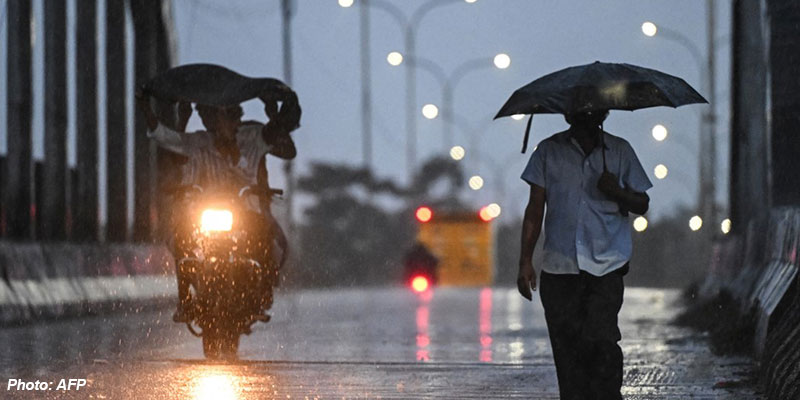
• The southwest monsoon is expected to set in early over Kerala on May 26, the India Meteorological Department (IMD) said in its forecast.
• The monsoon normally arrives in Kerala around June 1 and advances northwards to cover other parts of the country.
• The onset of monsoon in the state marks the beginning of the southwest monsoon season (June to September).
• Last year, the onset of the monsoon happened on May 24.
• The four-month monsoon season brings almost 70 per cent of the country’s annual rainfall.
• It is critical for agriculture and crops, for the economy as a whole, and to recharge reservoirs and aquifers.
• The IMD has said that India might receive below-normal rainfall this year during the monsoon season.
• The country is likely to get 80 cm of rainfall in the monsoon months, with the long-period average (1971-2020) of seasonal rainfall at 87 cm.
• This could be due to the emergence of the El Nino conditions, which cause less rainfall in the country.
Southwest Monsoon & Northeast Monsoon
• The word monsoon comes from the Arabic word “mausim”, which means weather.
South Asia experiences two monsoons:
i) Southwest Monsoon or summer monsoon during June to September.
ii) Northeast Monsoon or winter monsoon during October to December.
• The annual oscillation in the apparent position of the Sun between the Tropics of Cancer and Capricorn causes the annual oscillation in the position of the thermal equator (region of maximum heating) on the Earth’s surface. This is associated with the annual oscillation of temperature, pressure, wind, cloudiness, rain etc.
• On the Earth’s surface, there are asymmetries of land and Ocean. The differential heating of land and Ocean causes variations in the intensity of the annual oscillation of the thermal equator and hence regional variations in the intensity of monsoon.
• The south-westerly wind flow occurring over most parts of India and Indian seas gives rise to southwest monsoon over India from June to September.
• While the southwest monsoon is responsible for a major portion of annual rainfall over India, rainfall received during the northeast monsoon season (October-December) is also important, especially for the south peninsula, Sri Lanka and Maldives.
• In India, the northeast monsoon season contributes about 11 per cent of its annual rainfall over the country as a whole.
• The south peninsula receives much more rainfall compared to northern parts of the country. Many districts over the south peninsula receive 30-60 per cent of the annual rainfall during this season.
• During the southwest monsoon season, surface pressure gradient is directed from the Indian Ocean to land with southwesterly monsoon winds in the lower troposphere.
• During the northeast monsoon season, the pressure gradient reverses (from land to the Indian Ocean) resulting in northeasterly trade winds, which is the basic state of the system.
• This change in surface pressure gradient and lower tropospheric winds is associated with the southward movement of the continental tropical convergence zone (CTCZ) and the subtropical anticyclone in the upper troposphere.
• Therefore, the northeast monsoon is often described as the retreating phase of the southwest monsoon.