
- India
- May 17
- Sreesha V.M
India, Netherlands elevate ties to ‘Strategic Partnership’
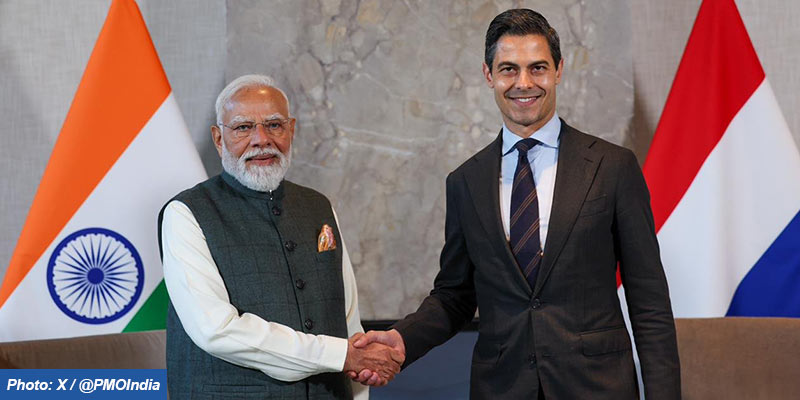
• Prime Minister Narendra Modi paid an official visit to the Netherlands on May 16 and 17.
• PM Modi was hosted by King Willem Alexander and Queen Maxima of the Netherlands at the Royal Palace Huis ten Bosch in the Hague for a bilateral meeting.
• Later, PM Modi held talks with his Dutch counterpart Rob Jetten.
• They welcomed the adoption of a ‘Strategic Partnership Roadmap’ under which both sides agreed to work through regular and structured cooperation in all areas.
• Both sides inked agreements to boost cooperation in defence, critical minerals and other key sectors.
Key outcomes of the meeting:
• MoU on migration and mobility. The two countries also agreed to further strengthen cooperation with a view to prevent and combat irregular migration and trafficking of human beings, and encourage the fair mobility of highly skilled professionals.
• MoU on a partnership on semiconductors and related emerging technology, which provides the framework for intensified cooperation in semiconductors, including in the areas of investment, research and talent exchange.
• MoU on critical minerals. Recognising the strategic importance of critical minerals for continued innovation, and the need for global cooperation to build resilient and sustainable supply chains, the two leaders expressed their mutual interest in strengthening cooperation across the critical minerals value chain, including exploration, research and innovation, integration of value chains, supply chain resilience, circularity and ESG standards and related assessments.
• Both leaders welcomed the establishment of a Centre of Excellence on Water under the aegis of Ministry of Jal Shakti in collaboration with the Ministry of Infrastructure & Water Management, government of the Netherlands at the Indian Institute for Technology (IIT) Delhi. The leaders also noted the progress under various ongoing joint programs in the states of Uttar Pradesh, Maharashtra, West Bengal, Tamil Nadu and Kerala. Both leaders agreed to further enhance cooperation on the Kalpasar Project in Gujarat, where Dutch expertise and technical assistance in the Project can lead to the further strengthening of Strategic Partnership on Water.
• The leaders launched the ambitious India-Netherlands Roadmap on the Development of Green Hydrogen. They agreed that the roadmap will help support India’s ambition, vast potential and competitive advantages for production, usage and export of Green Hydrogen while also contributing to a swifter adoption of Green Hydrogen as a sustainable source of energy in both countries.
• The two leaders welcomed the establishment of a Joint Working Group under the MoU on renewable energy which provides ample scope for a diversified agenda for cooperation in renewable energy, including innovative solar energy, green hydrogen, storage and investments in the renewable energy sector to facilitate energy transition.
• Joint declaration between the Ministry of Fisheries, Animal Husbandry and Dairying and the Ministry of Agriculture, Fisheries, Food Security and Nature of the Netherlands as well as the establishment of an Indo-Dutch Center of Excellence on Training in Dairy at the Center of Excellence for Animal Husbandry (CEAH), Bengaluru. Both sides agreed to continue to explore cooperation in dairy and other allied agricultural sectors including food processing.
• Letter of Intent between the Dutch National Institute for Public Health and the Environment (RIVM) and the Indian Council of Medical Research (ICMR), focusing on areas such as infectious diseases, vector-borne diseases, One Health and disease surveillance.
• Signing of the agreement on mutual administrative assistance in customs matters, enabling the exchange of information between the customs authorities of the countries and thus contributing to enhanced customs enforcement and the facilitation of legitimate trade between India and the Netherlands.
• Signing of MoU on higher education between the Ministry of Education of India and the Ministry of Education, Culture and Science of the Netherlands to promote cooperation between the higher education institutions of the two countries, in accordance with their respective academic and educational priorities and needs.
(The author is a trainer for Civil Services aspirants.)