
- India
- May 18
President promulgates ordinance to increase strength of Supreme Court judges
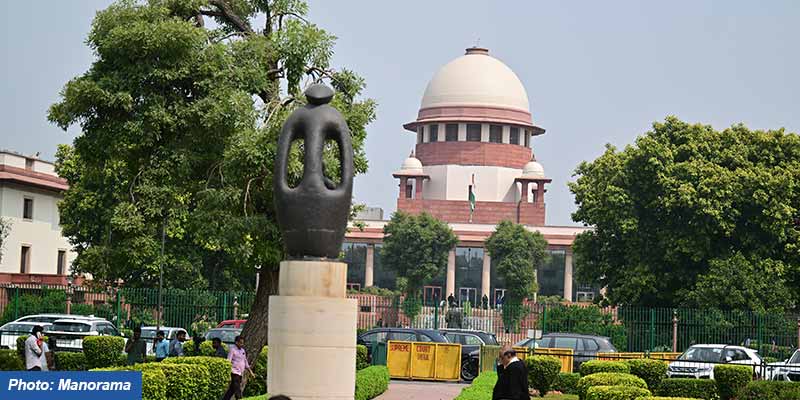
• President Droupadi Murmu promulgated an ordinance to increase the strength of the Supreme Court from the present 34 judges to 38, including the Chief Justice of India on May 16.
• The Ministry of Law and Justice notified the Supreme Court (Number of Judges) Amendment Ordinance 2026.
• It amended the Supreme Court (Number of Judges) Act, 1956, to increase the sanctioned strength of the Supreme Court.
• So far, the sanctioned strength of the Supreme Court was 34, including the Chief Justice of India (CJI).
• On May 5, the Union Cabinet cleared a proposal to increase the strength of the Supreme Court judges.
• The Supreme Court (Number of Judges) Amendment Bill, 2026 will be introduced in Parliament to amend The Supreme Court (Number of Judges) Act, 1956 for increasing the number of judges.
• The increase in the number of judges will allow the Supreme Court to function more efficiently and effectively ensuring speedy justice.
Increase in number of SC judges
• Article 124 (1) in Constitution of India inter-alia provided “There shall be a Supreme Court of India consisting of a Chief Justice of India and, until Parliament by law prescribes a larger number, of not more than seven other judges…”
• The Supreme Court (Number of Judges) Act 1956, as originally enacted, provided for the maximum number of judges (excluding the chief justice of India) to be 10.
• This number was increased to 13 by the Supreme Court (Number of Judges), Amendment Act, 1960, and to 17 by The Supreme Court (Number of Judges) Amendment Act, 1977.
• The Supreme Court (Number of Judges) Amendment Act, 1986, augmented the strength of the Supreme Court judges from 17 to 25, excluding the CJI.
• Subsequently, a fresh amendment in 2009 further augmented the strength of Supreme Court judges from 25 to 30.
• The strength of the Supreme Court was increased to 33 (excluding the CJI) by further amending the original law in 2019.
Article 123 - Power of President to promulgate ordinance
• Article 123 of the Constitution of India provides that ordinances having the same force and effect as an Act of Parliament may be issued by the President from time to time except when both the Houses of Parliament are in session, if the President is satisfied that circumstances demand immediate action.
• An ordinance promulgated under this Article shall have the same force and effect as an Act of Parliament.
• However, every such ordinance shall be laid before both the Houses of Parliament and shall cease to operate at the expiration of six weeks from the reassembly of Parliament.
• The constitutional history relating to the ordinance-making power of the President in India is traceable to the Indian Councils Act, 1861.
• Under this Act, the Governor-General could promulgate Ordinances in case of Emergency which could remain in force for not more than six months.
• The government of India Act, 1935 provided for promulgation of ordinances by the Governor-General in his discretion or in exercise of his individual judgement.
• The Governor-General was, however, required to obtain previous instructions from the Crown in certain cases.
• The Governor-General also had the power to issue ordinances even when the Legislature was in session.
• An ordinance could remain in force for not more than six months and extension for a further period not exceeding six months was possible by a subsequent ordinance.
• The restriction on the period of operation of the Ordinance was removed by the India and Burma (Emergency Provisions) Act, 1940.
• This provision continued till the enactment of the India and Burma (Termination of Emergency) Order, April 1, 1946.
• Under the 1935 Act, the Crown had the power to disallow an ordinance.
• The India (Provisional Constitution) Order, 1947, however, omitted this provision.