
- India
- May 26
Raghav Chadha appointed chairman of Rajya Sabha Committee on Petitions
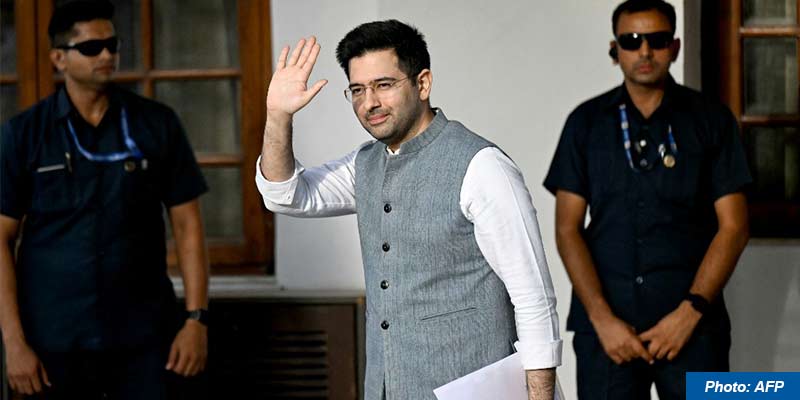
• Rajya Sabha MP Raghav Chadha has been appointed as the new chairman of the Committee on Petitions of the Upper House.
• Chadha exited the Aam Aadmi Party (AAP) in April to join the Bharatiya Janata Party (BJP).
• After reconstituting the Committee on Petitions, Rajya Sabha Chairman C.P. Radhakrishnan nominated 10 members of the house to the panel.
• The panel has been reconstituted by the Rajya Sabha Chairman with effect from May 20.
• The members of the panel besides Chadha are: Harsh Mahajan, Gulam Ali, Shambhu Sharan Patel, Mayankkumar Nayak, Masthan Rao Yadav Beedha, Jebi Mather Hisham, Subhasish Khuntia, Rwngwra Narzary and Sandosh Kumar P.
Committee on Petitions
• The Committee on Petitions is one of the oldest committees of Parliament and dates back to the Legislative Assembly of the pre-Independence period.
• It owes its origin to a resolution moved by a member in the then Council of State on September 15, 1921.
• The resolution called for the setting up of a Committee on Public Petitions with powers to take evidence.
• The matter was examined by a Committee appointed by the government.
• This Committee did not favour giving to the Legislature the powers proposed in the resolution.
• The right of petitioning the Legislature, limited to public business, was, however, recommended by it.
• The Committee received its present nomenclature, namely the Committee on Petitions in 1933.
• Rajya Sabha came into being in the year 1952 and the Committee on Petitions of Rajya Sabha was constituted in the same year with a Chairman and four other members.
• The membership of the Committee continued to be five till the year 1964 when it was increased to ten, and since then the Committee continues to be composed of ten members.
• The Committee is constituted under Rule 147 of the Rules of Procedure and Conduct of Business in Rajya Sabha.
• Members of the Committee are nominated by the Rajya Sabha Chairman.
• The Chairman of the Committee is appointed by the Chairman of Rajya Sabha from amongst the members of the Committee.
• Normally, the Committee is reconstituted every year.
• The Committee, however, continues in office till a new Committee is nominated.
Presentation of petition to the House
• A petition requires to be drawn up in a prescribed form set out in the First Schedule to the Rules of Procedure and Conduct of Business in Rajya Sabha and may be used with such variation as the circumstances of each case require and when it is so used it is considered sufficient and should be formally addressed to Rajya Sabha.
• A member who desires to present a petition to the House, has to give advance notice thereof to the Secretary-General, Rajya Sabha.
• After receipt of the petition, it is examined by the Secretariat to determine its admissibility according to the Rules.
• If the Chairman of Rajya Sabha admits the petition, the member concerned is permitted to present the petition on a date convenient to him and the necessary entry is made in the list of business of the day for the presentation of the petition.
• The presentation of petition is done immediately after papers are laid on the Table.
• Prior to 1964, when petitions could be presented only on Bills or other matters pending before the House, the Secretary-General used to receive petitions on pending Bills from individuals and bodies, and report them to the House. These provisions still continue to exist.
• The committee can accept and examine petitions regarding any matter of general public interest that falls primarily under the jurisdiction of the central government.
• Matters within the jurisdiction of courts, statutory tribunals, or quasi-judicial bodies are barred from being examined by the committee.
• Only those petitions which are countersigned by a Member of Rajya Sabha are presented to the House and rest of the petitions as are found in conformity with the rules are reported by the Secretary-General to the House.
• No discussion or debate is permitted at the time of presentation of the petition.
• After presentation by a member or reported by the Secretary-General as the case may be, every petition stands automatically referred to the Committee.
The functions of the Committee are:
i) To examine every petition referred to it, and if the petition complies with the rules, to direct that it be circulated in extenso or in summary form, as the case may be.
ii) To report to the House on specific complaints made in the petition after taking such evidence as it deems fit and to suggest remedial measures, either in a concrete form applicable to the case under consideration or to prevent recurrence of such case.
• The reports of the Committee are presented to the House by the Chairman of the Committee or in his absence by any member of the Committee from time to time.