
- India
- May 27
- Sreesha V.M
India hosts 11th Quad Foreign Ministers’ Meeting
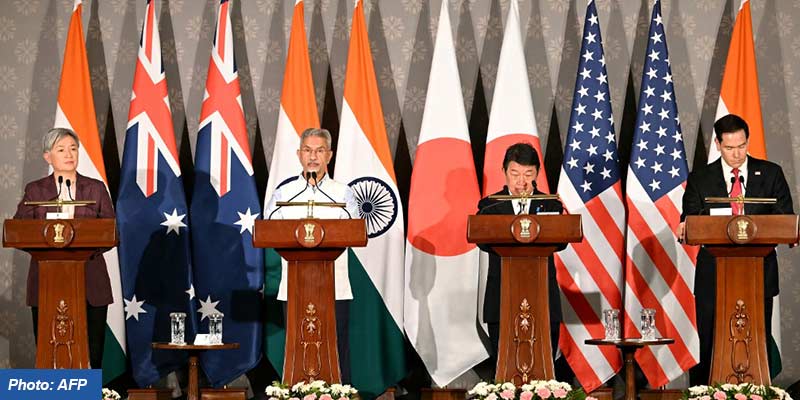
• Foreign Ministers of India, Australia, Japan and the Secretary of State of the United States of America, met in New Delhi for the 11th Quad Foreign Ministers’ Meeting on May 26.
• The meeting was chaired by Minister of External Affairs S. Jaishankar and attended by US Secretary of State Marco Rubio, Australian Foreign Minister Penny Wong, and Japanese Foreign Minister Toshimitsu Motegi.
What is Quad?
• The Quad, or the Quadrilateral Security Dialogue, is an informal grouping of four countries — Australia, India, Japan and the United States.
• It is a diplomatic partnership of four countries committed to promoting stability, resilience and prosperity in the Indo-Pacific.
• The four countries came together 20 years ago to extend assistance in response to the 2004 Indian Ocean earthquake and tsunami, and that coalition subsequently took form of the Quad.
• The 2024 tsunami was one of the worst disasters in history, claiming the lives of nearly a quarter million people and displacing 1.7 million across 14 countries.
• The four countries contributed over 40,000 emergency responders, working with other partners across the Indo-Pacific region to support millions of people affected by the catastrophe.
• The Quad has since become a leading regional partnership dedicated to advancing a common vision of a free and open Indo-Pacific through practical cooperation on diverse 21st-century challenges.
• The foreign ministers of the four countries held their first meeting under the Quad framework in New York in September 2019.
• The first Leaders’ Summit of the Quad was held virtually in March 2021.
• The Quad recognises that international law, peace, and security in the maritime domain underpins the development and prosperity of the Indo-Pacific.
• The countries are determined to deepen engagement with regional partners, including through capacity-building and technical assistance, to strengthen maritime domain awareness, protect their ability to develop offshore resources, consistent with the UN Convention on the Law of the Sea (UNCLOS).
• The Quad is exchanging information on ever-evolving threats and working with Indo-Pacific countries, and in multilateral fora, to counter all forms of terrorism and violent extremism.
• Quad partners champion the free, open, and inclusive rules-based order, rooted in international law, that protects the sovereignty and territorial integrity of regional countries.
• The Quad has been focusing on cooperation in areas such as producing vaccines, connectivity projects, facilitating the mobility of students and looking at promoting startups and technology collaboration.
• The Quad countries now work together and with partners across the Indo-Pacific to address complex challenges — from fighting climate change, cancer and pandemics, to bolstering quality infrastructure, counter-terrorism efforts, critical and emerging technologies, and cybersecurity.
Key outcomes of the meeting:
• The Quad partners launched the first ever Indo-Pacific Maritime Surveillance Collaboration (IPMSC) initiative to leverage Quad country maritime surveillance in the Indo-Pacific, enhancing information sharing and maritime domain awareness capacity with an initial focus on the Indian Ocean Region as well as through subject matter expert exchanges and tabletop exercises.
• The Quad partners expanded their work as part of the Indo-Pacific Partnership for Maritime Domain Awareness (IPMDA). Quad countries are developing a comprehensive Common Operating Picture (COP). The IPMDA initiative enhances maritime domain awareness in the Indo-Pacific, harnessing real-time information in Indo-Pacific maritime zones which will have benefits for the entire region.
• India will host the next edition of the Quad-at-Sea Ship Observer Mission to strengthen interoperability and knowledge-sharing to best address unlawful maritime activities across the region.
• They announced the new Quad Critical Minerals Initiative Framework. Quad partners intend to mobilise up to $20 billion in government and private sector support through new and existing efforts to strengthen critical minerals supply chains, including in mining, processing, and recycling.
• Quad Initiative on Indo-Pacific Energy Security to help strengthen regional energy resilience was announced. Each country will leverage unique resources and capabilities from their respective energy sectors. Through this initiative, Quad partners will work to identify areas of cooperation in technology, management, policy, international market analysis, and emergency response exercises.
• Undersea cable systems are the backbone of the global digital economy and essential to secure, reliable, and resilient connectivity across the Indo-Pacific. Quad partners have provided tangible support to ensure that all Pacific Island Forum countries are connected via undersea cables by 2026 to secure their digital futures. They will continue to explore opportunities to support future undersea cable connections in the region to further provide trusted redundancy.
• Following the successful Quad Ports of the Future Partnership Conference hosted by India in October 2025, which was aimed at advancing the Quad vision for resilient and secure ports, Quad countries will work, in coordination with the government of Fiji, to advance port infrastructure and associated activities in the country.
(The author is a trainer for Civil Services aspirants.)