
- India
- May 27
India, US ink pact to secure critical minerals supply chain
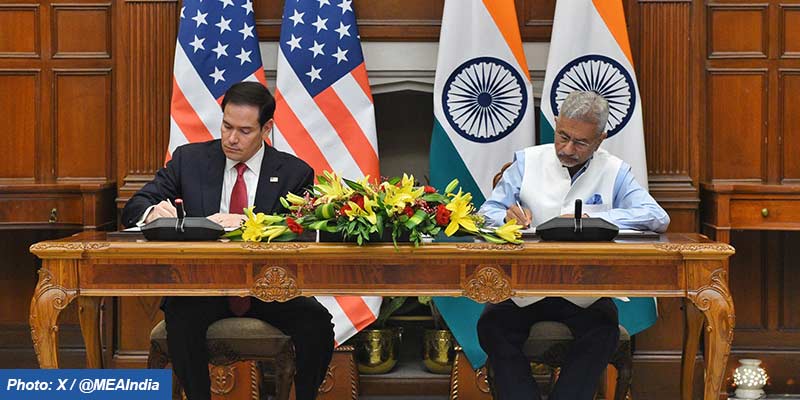
• India and the United States concluded a framework on ‘Securing of Supply in the Mining and Processing of Critical Minerals and Rare Earths’.
• The framework was signed by Minister of External Affairs S. Jaishankar and US Secretary of State Marco Rubio on the sidelines of the Quad Foreign Ministers’ Meeting in New Delhi on May 26.
• The framework aims to deepen India-US cooperation across the critical minerals and rare earths supply chain, including mining, processing, recycling and related investments.
• It seeks to strengthen resilient and diversified supply chains, while promoting collaboration in financing and effective management of critical minerals and rare earths scrap.
• It builds on continuing India-US cooperation aimed at strengthening supply chain security in critical sectors.
What are critical minerals?
• One definition suggests that a mineral is labelled as critical when the risk of supply shortage and associated impact on the economy is higher than the other raw materials.
• They are metals, non-metals and minerals that are considered vital for the economic well-being of the world’s major and emerging economies, yet whose supply may be at risk due to geological scarcity, geopolitical issues, trade policy or other factors.
• Critical minerals are essential for economic development and national security. The lack of availability of these minerals or even concentration of existence, extraction or processing of these minerals in few geographical locations may lead to supply chain vulnerability and disruption.
• The future global economy will be underpinned by technologies that depend on minerals such as lithium, graphite, cobalt, titanium, and rare earth elements (REE).
• Each country has its own classification of raw materials or critical minerals depending on levels of economic development, industry requirements, national interests and security concerns, technology, market changes and natural resource endowment.
• The most common framework widely adopted for evaluating material criticality is based on a metal’s supply risk and the impact of a supply restriction.
• Critical minerals include rare earth elements (REEs) and platinum-group elements.
• Critical minerals are crucial for manufacturing advanced technologies like mobile phones, computers, fiber-optic cables, semiconductors, and banknotes.
• They are essential for low-emission technologies such as electric vehicles, wind turbines, solar panels, and rechargeable batteries.
• China accounts for around 70 per cent of global rare earth mining that makes it a very dominant player in the global supply chain of the critical minerals.
• India has been looking at a steady supply of rare earth minerals to fuel its economic growth.
• The US government is mobilising unprecedented resources to secure critical mineral supply chains, supporting projects with more than $30 billion in investments, loans, and other support in partnership with the private sector.
• On February 20, 2026, India became a signatory to the US-led Pax Silica initiative. It was launched in December 2025 to build a secure, resilient, and innovation-driven supply chain for critical minerals and artificial intelligence.