
- India
- May 28
- Sreesha V.M
Railways approves country’s first hydrogen-powered train in Haryana
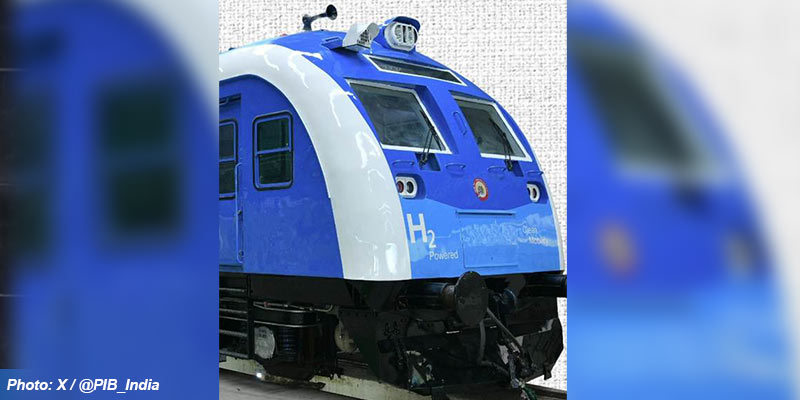
• Indian Railways approved the introduction of a 10-car Hydrogen Fuel Cell-based trainset on the dedicated Jind-Sonipat section of Northern Railway.
• The trainset is all set to start soon and will operate at a maximum speed of 75 kmph.
• It will have a total power output of 1,200 kilowatts and will operate on Distributed Power Rolling Stock (DPRS) technology, under which power is distributed across the train instead of being concentrated in a single locomotive.
Hydrogen fuel cell technology
• A fuel cell uses the chemical energy of hydrogen or other fuels to cleanly and efficiently produce electricity.
• If hydrogen is the fuel, the only products are electricity, water, and heat. Fuel cells are unique in terms of the variety of their potential applications
• Fuel cells have several benefits over conventional combustion-based technologies currently used in many power plants and vehicles.
• Fuel cells can operate at higher efficiencies than combustion engines and can convert the chemical energy in the fuel directly to electrical energy.
• Fuel cells work like batteries, but they do not run down or need recharging.
• They produce electricity and heat as long as fuel is supplied.
• A fuel cell consists of anode (a negative electrode) and cathode (a positive electrode) sandwiched around an electrolyte.
• A fuel, such as hydrogen, is fed to the anode, and air is fed to the cathode.
• In a hydrogen fuel cell, a catalyst at the anode separates hydrogen molecules into protons and electrons, which take different paths to the cathode.
• The electrons go through an external circuit, creating a flow of electricity.
• The protons migrate through the electrolyte to the cathode, where they unite with oxygen and the electrons to produce water and heat.
• Hydrogen fuel cell technology generates electricity through a chemical reaction using hydrogen, with water vapour as the only emission, making it a clean alternative to conventional fossil fuel-based traction systems.
• Hydrogen-based rail systems are increasingly being recognised globally as a promising solution for sustainable mobility.
• As the technology is still at a nascent stage, only a limited number of countries are currently operating or testing such systems.
• With this initiative, India joins a select group of countries such as Germany, Japan, China and the United States that are exploring the use of hydrogen for cleaner rail transportation.
• The Jind-Sonipat section in Haryana has been identified as the pilot route for these operations.
• An indigenous hydrogen storage and refuelling facility has been set up at Jind for the trainset.
• The Petroleum and Explosives Safety Organisation (PESO) has granted the required licence for storage and dispensing of compressed hydrogen gas at the site.
(The author is a trainer for Civil Services aspirants.)