
- India
- Jun 05
Explainer - Vibrant Village Programme
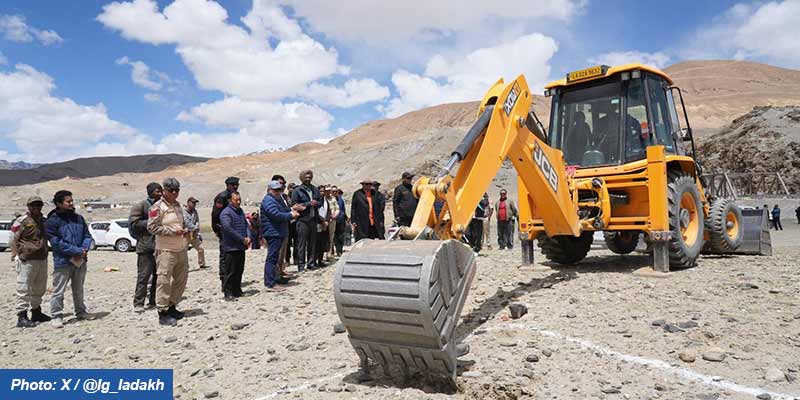
• Ladakh Lieutenant Governor V.K. Saxena laid the foundation stone for the first model border village at Chumur under the government of India’s Vibrant Village Programme (VVP).
• It is aimed at strengthening border habitation and improving the quality of life of residents living in remote frontier regions.
• Perched at an altitude of 16,700 feet along the Indo-China Border, Chumur houses 24 households with a population of 91 people, who are all engaged with Pashmina rearing and production.
• The development plan for Chumur will focus on infrastructure creation, employment and livelihood generation, tourism promotion, all-weather functionality and stronger civilian-defence integration.
• Special emphasis will be placed on promoting Pashmina products and local handicrafts to encourage self-reliance and help reverse migration from border areas.
• The Union Territory will develop 10 model border villagers in the first phase.
• The project is expected to serve as a model for sustainable development in remote border regions while improving living standards and economic opportunities for local communities.
Vibrant Villages Programme
• The first phase of Vibrant Villages Programme (VVP-I) was approved as a Centrally Sponsored Scheme on February 15, 2023 for comprehensive development of the 662 select villages in 46 blocks abutting northern border in 19 districts in the states of Arunachal Pradesh, Himachal Pradesh, Sikkim, Uttarakhand and UT of Ladakh.
• The programme envisages focused areas of interventions in the select villages for creation of opportunities for livelihood generation through promotion of tourism & cultural heritage, skill development & entrepreneurship and development of cooperative societies including agriculture/horticulture, cultivation of medicinal plants/herbs, etc.
• The programme would help in the comprehensive development of the villages located in the blocks abutting international land borders, other than the northern border already covered under VVP-I.
• With a total outlay of Rs 6,839 crore, the programme shall be implemented in select strategic villages in states/UTs of Arunachal Pradesh, Assam, Bihar, Gujarat, J&K (UT), Ladakh (UT), Manipur, Meghalaya, Mizoram, Nagaland, Punjab, Rajasthan, Sikkim, Tripura, Uttarakhand, Uttar Pradesh and West Bengal till the FY 2028-29.
• The objective of the programme is to create better living conditions and adequate livelihood opportunities to ensure prosperous and safe borders, control trans-border crime and assimilate the border population with the nation and inculcate them ‘as eyes and ears of the border guarding forces’, crucial for internal security.
• The programme shall provide funds for infrastructure development within the village or a cluster of villages, value chain development (through cooperatives, self-help groups, etc), border specific outreach activity, education infrastructure like SMART classes, development of tourism circuits and works/projects to create diverse & sustainable livelihood opportunities in the border areas.
• The interventions would be border-specific, state and village specific, based on Village Action Plans prepared in a collaborative approach.
• All-weather road connectivity for these villages shall be undertaken under the already approved Rural connectivity under Pradhan Mantri Gram Sadak Yojana (PMGSY-IV) under the Ministry of Rural Development.
• A high-powered committee chaired by the Cabinet Secretary shall consider suitable relaxations in schematic guidelines for effective implementation of schemes in the border areas.
• The programme aims to achieve saturation in existing individual and household level welfare schemes in the identified villages under convergence as per scheme norms.
• The programme emphasises enhancing vibrancy in these villages by organising activities including fairs & festivals, awareness camps, celebration of national days, regular visits by ministers, senior government officers from central and state/Union territory government and night stays in such villages.
• This would boost the tourism potential and promote the local culture and heritage of these villages.