
- India
- Jun 06
India launches E85 fuel for flex-fuel vehicles
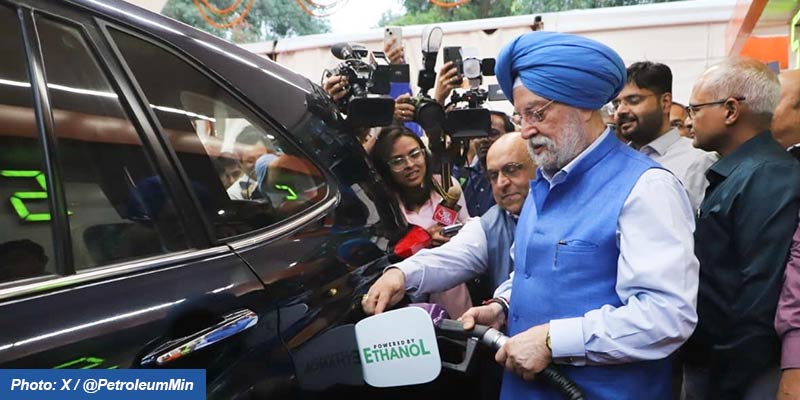
• India launched E85 fuel, a high-ethanol blend designed for flex-fuel vehicles, on June 5.
• Union Petroleum and Natural Gas Minister Hardeep Singh Puri unveiled the fuel at an IndianOil retail outlet in New Delhi on World Environment Day, with the rollout beginning at 48 public sector fuel stations nationwide.
• The minister said the government plans to expand its availability to 500 outlets by December 2026 and to about 5,000 outlets by December 2027.
• The government has priced E85 at nearly Rs 20 per litre below conventional petrol.
• E85 contains 80-85 per cent ethanol and 14-19 per cent petrol, and can be used only in flex-fuel vehicles capable of operating on ethanol blends ranging from E20 to E100.
• The initiative aims to facilitate the adoption of flex-fuel vehicles, which are capable of operating on ethanol blends from E20 to E100, without restricting consumers to a single blend.
• The expansion of E85 infrastructure is expected to help raise India’s overall ethanol blending level to nearly 26 per cent by 2030-31.
Why govt promotes E85 fuel?
• NITI Aayog officially classifies ethanol-based flex-fuel vehicles (FFVs), including vehicles running on high ethanol blends such as E85, as zero-emission vehicles.
• E85 fuel also produces near-zero particulate matter (PM) emissions, making FFVs a promising solution for addressing the country’s growing air pollution challenge.
• India has increased ethanol blending in petrol from 1.53 per cent in 2014 to 20 per cent currently, achieving its target five years ahead of schedule.
• The programme has helped save more than Rs 1.84 lakh crore in foreign exchange and reduced crude oil imports by nearly 302 lakh metric tonnes.
• With a Research Octane Number (RON) of about 108, ethanol offers superior knock resistance that allows engines to operate at higher compression ratios and optimized ignition timing.
• Higher ethanol blends promote cleaner and more complete combustion, resulting in near-zero particulate matter emissions contributing to improved urban air quality.
• According to ministry estimates, flex-fuel vehicles running on E85 can reduce lifecycle greenhouse gas emissions by around 61 per cent compared with conventional petrol vehicles.
• Puri said that if half of all new two-wheelers and passenger vehicles sold in India shift to flex-fuel technology, annual ethanol demand could rise by more than 312 crore litres, generating roughly Rs 12,403 crore in additional income for farmers.
• Such a transition could also save about Rs 15,151 crore in foreign exchange annually and cut carbon dioxide emissions by 66.4 lakh metric tonnes.
• Drawing comparisons with Brazil, where more than 80 per cent of light vehicles operate on flex-fuel technology, Puri said India was moving from pilot projects to a structured national flex-fuel ecosystem.
What are flex-fuel engines?
• A flexible-fuel vehicle (FFV), as its name implies, has the flexibility of running on more than one type of fuel.
• FFVs have an internal combustion engine and are capable of operating on petrol and any blend of petrol and ethanol/methanol.
• Like conventional petrol vehicles, FFVs have a single fuel tank, fuel system, and engine.
• Some special ethanol-compatible components are required to compensate for the different chemical properties and energy content in ethanol, such as modifications to the fuel pump and fuel injection system.
• While fuel economy (mileage) is generally lower with increased levels of ethanol (due to the lower energy content in ethanol as compared to petrol and because the engines are optimised for petrol), many FFVs have improved acceleration performance when operating on higher ethanol blends.
• In the West, FFVs have been produced since the 1990s, and more than one hundred models are available.
Challenges for adoption of FFVs:
• From the customer perspective, flex-fuel vehicles may not seem feasible in India, since the cost of ownership and running cost are going to be very high compared with regular vehicles.
• FFVs could be more expensive than regular vehicles due to the upgradation of materials, engine parts and fuel system. Further, running cost (due to lower fuel efficiency) will be higher by more than 30 per cent.
• Unless the fuel cost of FFVs at retail outlets is made cheaper, customers may not prefer these vehicles. Customer acceptance will be the big challenge in this case.
• Development effort of a flex fuel vehicle is much higher than regular vehicles considering that the control systems have to be calibrated with multiple blends to derive optimum efficiency and meet emission regulations. Investing in development of such vehicles is not viable if the fuel is not available across the country.