
- India
- Jun 06
- Sreesha V.M
India records GDP growth of 7.7% in FY25
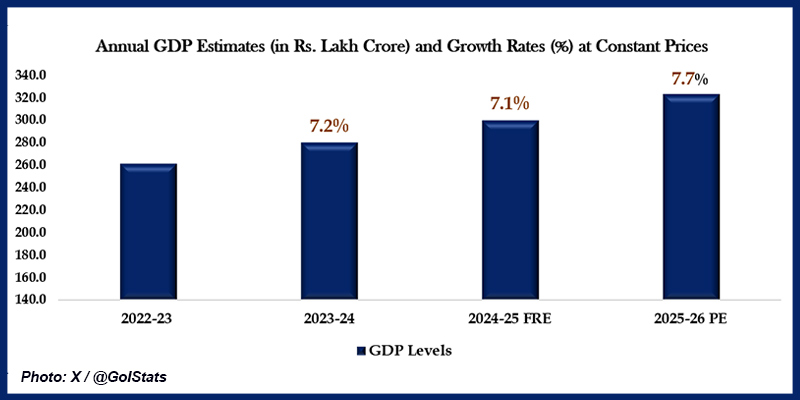
• The Ministry of Statistics and Programme Implementation (MoSPI) released the Provisional Estimates (PE) of Annual Gross Domestic Product (GDP) for the financial year 2025-26 and Quarterly Estimates of GDP for the Fourth Quarter (January-March) of FY 2025-26 on June 5.
• This is the second set of GDP data in the new series with 2022-23 as the base year.
• In the January-March period of the 2025-26 financial year, the GDP has been estimated to grow 7.8 per cent.
• Real GDP or GDP at constant prices is estimated to attain a level of Rs 323.12 lakh crore in the 2025-26, against the First Revised Estimate (FRE) of GDP for 2024-25 of Rs 299.89 lakh crore.
• Nominal GDP, or GDP at current prices, has been estimated to attain a level of Rs 346.36 lakh crore in 2025-26, against Rs 318.07 lakh crore in 2024-25, showing a growth rate of 8.9 per cent.
• Real Gross Value Added (GVA) is estimated at Rs 294.91 lakh crore in the year 2025-26, against Rs 273.36 lakh crore in FY 2024-25, registering a growth rate of 7.9 per cent as compared to 7.3 per cent growth rate in 2024-25.
• Nominal GVA is estimated to attain a level of Rs 314.87 lakh crore during FY 2025-26, against Rs 288.54 lakh crore in 2024-25, showing a growth rate of 9.1 per cent.
• Secondary and tertiary sectors have boosted the performance of the economy by registering growths of 8.8 per cent and 9.3 per cent, respectively, during FY26.
• These sectors include construction, manufacturing, trade, hotels, transport, communication and services related to broadcasting, storage, and financial, real estate, IT, professional services and ownership of dwelling.
• The primary sector registered 3.2 per cent growth rate mainly driven by the performance of agriculture and fishery sectors.
What is Gross Domestic Product (GDP)?
• Gross Domestic Product (GDP) is the most common measure for the size of an economy.
• It measures the total value of goods and services produced by that economy during a specific time period, typically a year or a quarter.
• This helps to understand changes in the size of an economy across different time periods and serves as a broad indicator for the standard of living of its population.
• It can be calculated for a country, a region, or for groups of countries, such as the European Union.
• Policymakers, businesses, and institutions use GDP to make key economic decisions.
(The author is a trainer for Civil Services aspirants.)