
- India
- Jun 09
West Bengal joins Ayushman Bharat-Pradhan Mantri Jan Arogya Yojana (AB-PMJAY)
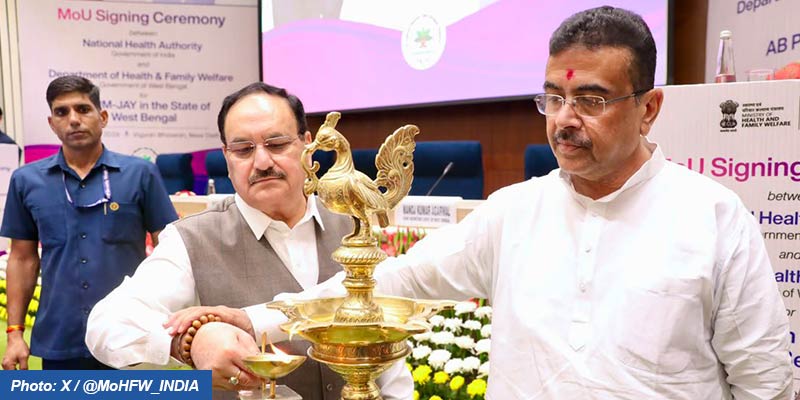
• West Bengal joined the Ayushman Bharat Pradhan Mantri Jan Arogya Yojana (AB-PMJAY) on June 8.
• The National Health Authority (NHA), under the Union Ministry of Health and Family Welfare (MoHFW), signed a Memorandum of Understanding (MoU) with the Department of Health & Family Welfare, government of West Bengal, for the implementation of AB-PMJAY in the state.
• With the signing of the MoU, West Bengal became the 36th state/Union Territory in the country to implement the Ayushman Bharat scheme. It was the only state that did not join the scheme earlier.
• The MoU signing ceremony was presided over by Union Minister of Health and Family Welfare J.P. Nadda in the presence of West Bengal Chief Minister Suvendu Adhikari.
• With the implementation of AB-PMJAY in West Bengal, approximately 1.43 crore families, including 1.24 crore eligible beneficiary families, around 3.06 lakh families of ASHAs, anganwadi workers and helpers, and nearly 15.95 lakh families of senior citizens aged 70 years and above, will now be able to avail the benefits of the scheme.
Ayushman Bharat-Pradhan Mantri Jan Arogya Yojana (AB-PMJAY)
• Over the past few decades there has been improvement in various health indicators of India. However, the out-of-pocket expenditure, which pushes millions of people into poverty every year.
• In order to address this and provide health cover of Rs 5 lakh per family per year for secondary and tertiary care hospitalisation to poor and vulnerable section of the population,
• Ayushman Bharat-Pradhan Mantri Jan Arogya Yojana (AB-PMJAY) was launched, subsuming the erstwhile Rashtriya Swasthya Bima Yojana, on September 23, 2018.
• It is the largest publicly funded health assurance scheme in the world.
• Initially, 10.74 crore poor and vulnerable families comprising the bottom 40 per cent of India's population were covered under the scheme.
• In January 2022, the Union government revised the beneficiary base from 10.74 crore to 12 crore families considering India’s decadal population growth of 11.7 per cent over the 2011 population.
• The scheme was further expanded to cover 37 lakh ASHAs / anganwadi workers (AWW) / anganwadi helpers (AWH) working across the country and their families for free healthcare benefits.
• On October 29, 2024, the scheme was further extended to cover six crore senior citizens aged 70 years and above, representing 4.5 crore families, through the Vay Vandana Card, irrespective of their socio-economic status.
• Currently, the scheme is implemented in all states/UTs.
• All members of the eligible families irrespective of age are covered under the scheme.
• The funding of the scheme is shared between central and state governments.
• The ratio of central share to state share for all states except northeast states and Himalayan states and Union Territories with legislature, is 60:40.
• For northeast states and Himalayan states, the ratio is 90:10. In the case of Union Territories without legislatures, the central contribution of premium is 100 per cent.
• The AB-PMJAY scheme is completely cashless and paperless and without the concept of reimbursement. Beneficiaries can avail treatment under defined packages.
• It is an entitlement-based scheme. Eligible beneficiaries can directly visit any empanelled public or private hospital to avail cashless treatment. Ayushman cards are issued to the beneficiaries to create awareness about the scheme.
Major outcomes of the scheme:
• As on February 28, 2026, a total of 43.52 crore Ayushman Cards have been created, including 1.14 crore cards created under the Ayushman Vay Vandana category for senior citizens aged 70 years and above.
• A total of 36,229 hospitals have been empanelled under the scheme across the country, of which 19,483 are public and 16,746 are private hospitals.
• A total of over 12 crore hospital admissions amounting to Rs 1.82 lakh crore have been authorised under the scheme.
• One of the most significant outcomes of the government’s efforts has been the reduction in out-of-pocket expenditure on healthcare, which has declined from 64.6 per cent before 2018 to 43.4 per cent today.
• AB-PMJAY has enabled timely access to quality healthcare through a cashless, paperless and fully digital platform.