
- India
- Jun 10
PM Modi to participate in G7 Summit in France’s Evian
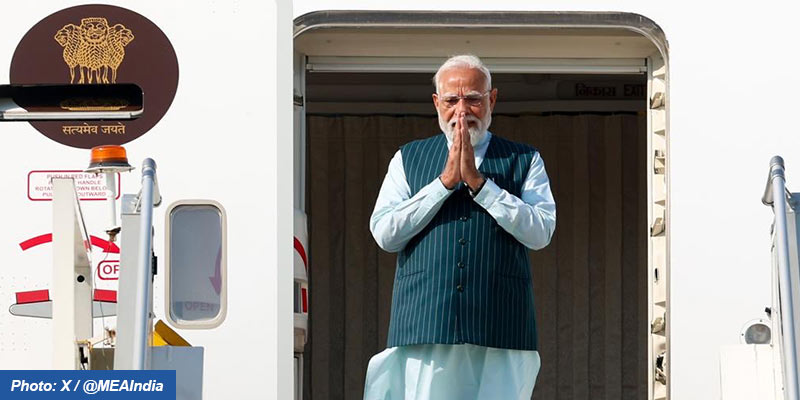
• Prime Minister Narendra Modi will undertake a week-long visit to France and Slovakia beginning on June 13,
• In the first leg of the visit, PM Modi will visit Nice for a bilateral meeting with President Emmanuel Macron on June 14.
• Both leaders will review the full spectrum of the India-France bilateral relationship, which was elevated to the level of a Special Global Strategic Partnership earlier this year.
• In the second leg of the trip, PM Modi will travel to Slovakia for a State visit.
• This will be the first-ever visit by an Indian Prime Minister to Slovakia since its Independence in 1993.
• The visit follows President Droupadi Murmu’s State Visit to Slovakia in April 2025 and Slovak President Peter Pellegrini’s visit to India for the AI Impact Summit in February 2026.
• In the third leg of the visit, PM Modi will participate in the G7 Summit in Evian on June 16 and 17.
• On the sidelines of the summit, PM Modi will also hold bilateral meetings with several world leaders.
What is Group of Seven (G7)?
• The G7 comprises the UK, Canada, France, Germany, Italy, Japan and the United States.
• It is the group of top seven developed economies.
• The Group was established as a platform for economic and financial cooperation in response to the 1973 energy crisis.
• The first Summit of Heads of State and government was held in November 1975 in Rambouillet, France. It included France, the United States of America, the United Kingdom, Germany, Japan, and Italy.
• In 1976, with the admission of Canada, the G7 took its current configuration. Since 1977, representatives of the European Economic Community, now the European Union, also participate in the work of the Group.
• Starting in the 1980s, the G7 expanded its focus to international security, human rights and global stability.
• Later, the G7 prioritised engagement with developing countries.
• The G7 has played a crucial role in strengthening international economic policies. It has advanced discussions on global issues such as climate change and gender equality, brought donors together and notably, supported disarmament programmes.
• The European Union is a ‘non-enumerated’ member and does not assume the rotating G7 presidency.
• The G7 expanded into the G8 between 1997 and 2013, with the inclusion of Russia.
• Russia was expelled from the G8 in 2014 when Barack Obama was US President, after Moscow annexed the Crimea region from Ukraine.
• The role as host, also known as the G7 presidency, rotates annually among member countries in the following order: France, United States, United Kingdom, Germany, Japan, Italy and Canada.
• The combined gross domestic product of G7 countries is about $40 trillion — a little less than half of the global economy.
• The annual G7 summits have over the years developed into a platform for determining the course of multilateral discourse and shaping political responses to global challenges.
• It complements the role of the G20, which is widely regarded as the framework for ongoing global economic coordination.
• It is capable of setting the global agenda, because decisions taken by these major economic powers have a real impact. The political direction set by these leaders on a policy issue will have a “ripple” effect across many other international organisations and institutions.
• Thus, decisions taken at the G7 are not legally binding, but exert strong political influence.
• India is not a member of G7. However, India has been a regular invitee to the G7 Summits.