
- India
- Jun 10
Amit Shah launches Land Port Management System
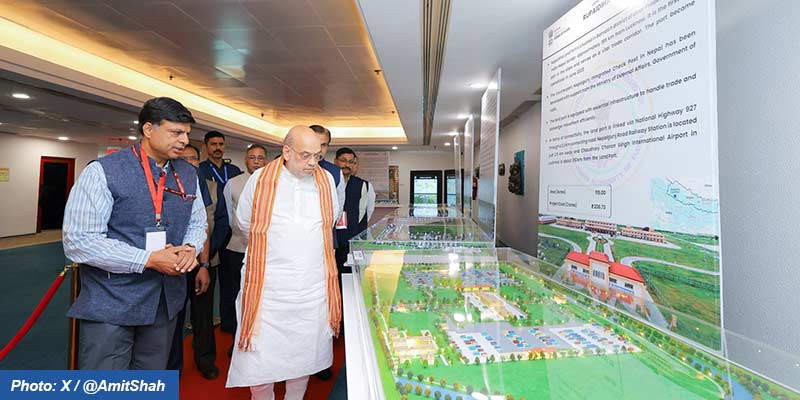
• Union Home Minister Amit Shah launched Land Port Management System — VINIMAY — in New Delhi on June 9.
Land ports in India
• India shares over 15,000 kms long international land border with seven countries in South Asia, namely Afghanistan, Bangladesh, Bhutan, China, Myanmar, Nepal and Pakistan.
• There are several designated entry and exit points for cross-border movement of persons, goods and vehicles.
• Moving beyond a security-centric approach, land ports were developed as the first line of defence for security, a means to facilitate trade, and a bridge for people-to-people connectivity.
• At the same time, land ports have played a significant role in the holistic development of border areas, promoting legitimate trade, and addressing challenges such as migration from border villages and districts.
• Easier movement of people across borders has strengthened mutual trust between the people of both countries and enhanced cultural exchange.
• Land ports are also known as Integrated Check Posts (ICPs).
• Trade through land ports has reached Rs 83,000 crore.
• Currently, 15 land ports are operational, and 11 additional land ports are expected to become operational over the next two to three years.
The 15 land ports are:
1) Attari (Punjab) along the India-Pakistan border
2) Dera Baba Nanak (Punjab) along the India-Pakistan border
3) Rupaidiha (Uttar Pradesh) along the India-Nepal border
4) Raxaul (Bihar) along the India-Nepal border
5) Jogbani (Bihar) along the India-Nepal border
6) Darranga (Assam) along the India-Bhutan border
7) Petrapole (West Bengal) along the India-Bangladesh border
8) Dawki (Meghalaya) along the India-Bangladesh border
9) Sutarkandi (Assam) along the India-Bangladesh border
10) Golakganj (Assam) along the India-Bangladesh border
11) Mankachar (Assam) along the India-Bangladesh border
12) Agartala (Tripura) along the India-Bangladesh border
13) Srimantapur (Tripura) along the India-Bangladesh border
14) Sabroom (Tripura) along the India-Bangladesh border
15) Moreh (Manipur) along the India-Myanmar border.
Land Ports Authority of India
• Land Ports Authority of India (LPAI) was constituted under Land Ports Authority Act, 2010 for development and management of facilities for cross border movement of passengers and goods at designated points along the international borders of India.
• Established as a statutory body under the Department of Border Management, Ministry of Home Affairs, the LPAI is entrusted with the task of building land ports on India’s borders and provide state-of-the-art infrastructure facilities to facilitate seamless and efficient movement of cargo and passengers.
• It has an overall objective of reducing dwell time and trade transaction costs, promote regional trade and people-to-people contact and imbibe the best international practices.
• LPAI endeavours to provide safe, secure and systematic facilities for movement of cargo as well as passengers at its ICPs.
Land Port Management System
• The launch of Land Port Management System (LPMS) is a landmark step in India’s journey towards modern, technology-enabled smart border management system, reflecting the nation’s strategic focus on strengthening trade facilitation, connectivity, and national security.
• The LPMS has been designed keeping in mind the requirements of all stakeholders, while giving special emphasis to security.
• Together with the Smart Border initiative, this system will help to create an impregnable and secure border management framework.
• The LPAI has developed a modern, digital, integrated, and real-time management system for its land ports, bringing all stakeholders onto a single platform.
• The system will provide an integrated digital platform for the management of cargo, passengers, and vehicles.
• It enables secure, real-time exchange of logistics and regulatory information, bringing land ports at par with digital systems operational at airports and seaports.
• Nearly 90 per cent of paperwork will be eliminated.
• As a neutral and open platform, LPMS will facilitate seamless coordination among various stakeholders, including government agencies and private operators, thereby reducing delays and enhancing operational efficiency.
• The single electronic window and Automatic Number Plate Recognition (ANPR)-based gate operation system will result in significant time savings.
• Truck waiting times are expected to be reduced by approximately 50 per cent, while gate processing times will reduce by about 30 per cent.
• This will not only boost trade but also promote tourism and facilitate better coordination, dialogue, and cultural exchange between the citizens of both countries.