
- India
- Jun 12
PM Modi chairs 11th Governing Council meeting of NITI Aayog
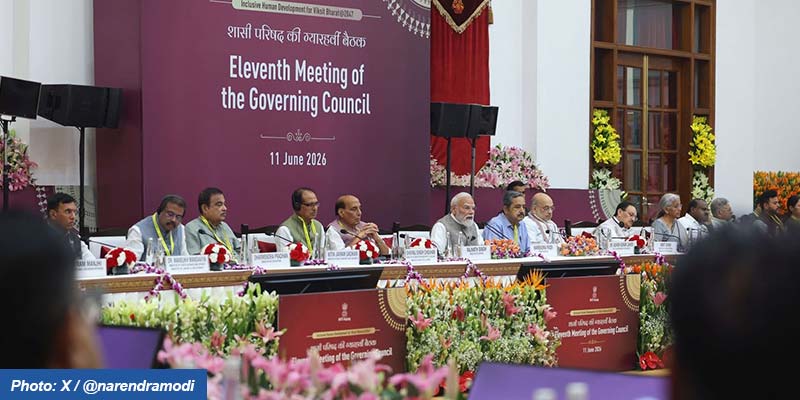
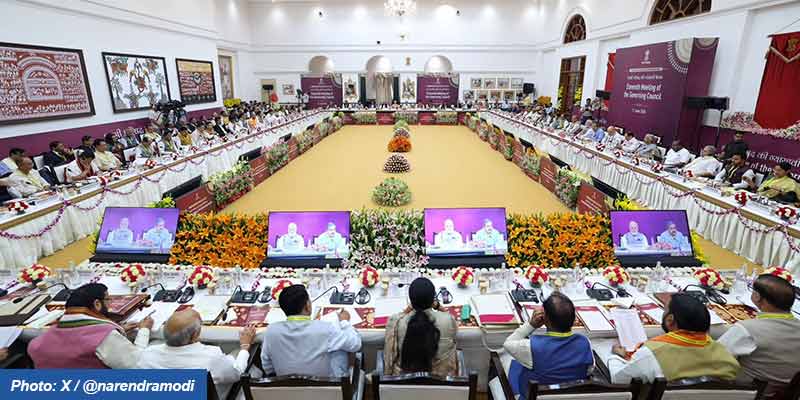
• Prime Minister Narendra Modi chaired the 11th Governing Council Meeting of NITI Aayog at Rashtrapati Bhavan Cultural Centre, New Delhi, on June 11.
• It was attended by Chief Ministers, Lt. Governors and Administrators representing 28 states and five Union Territories.
• This was the first time when Chief Ministers of all 28 states participated in the Governing Council Meeting of NITI Aayog.
• This year’s theme was “Inclusive Human Development for Viksit Bharat@2047”.
Key points highlighted by PM Modi:
• Underscoring the importance of cooperative federalism, PM Modi stated that the Centre and the states must work together to achieve the goal of a Viksit Bharat.
• The PM observed that the country’s youth constitute its greatest asset, with nearly 70 crore Indians below the age of 25 years. Calling this a demographic dividend, he urged states to focus on transforming it into a development dividend through education, skilling and capacity-building initiatives that prepare young people for future opportunities and challenges.
• Highlighting the importance of good governance, transparency, and infrastructure for attracting investment, he urged states to focus on branding, ease of doing business, and emerging opportunities in sectors such as data centres and artificial intelligence.
• He urged states to focus on One District One Product (ODOP) initiatives and develop export-oriented strategies around it.
• He emphasized the need to further strengthen the nation’s resolve towards self-reliance and highlighted the importance of adopting and implementing global best practices, particularly in the renewable energy sector.
What is NITI Aayog?
• National Institution for Transforming India, better known as NITI Aayog, was formed via a resolution of the Union Cabinet on January 1, 2015.
• The government constituted NITI Aayog to replace the Planning Commission, which had been instituted in 1950.
• NITI Aayog acts as the quintessential platform of the government of India to bring the states to act together in national interest, and thereby fosters cooperative federalism.
• It is the premier policy think tank of the government of India, providing directional and policy inputs. Apart from designing long-term policies and programmes for the government of India, NITI Aayog also provides relevant strategic and technical advice to the Centre, states, and Union Territories.
• NITI Aayog is developing itself as a state-of-the-art resource centre with the necessary knowledge and skills that will enable it to act with speed, promote research and innovation, provide strategic policy vision for the government, and deal with contingent issues.
Team NITI Aayog
• The Prime Minister is the chairperson of NITI Aayog. The vice chairperson is appointed by the Prime Minister. Currently, there are five full-time members. Union ministers are nominated by the Prime Minister as Ex-officio members. Special Invitees are also nominated to NITI Aayog.
• Chief Executive Officer (CEO) is appointed by the Prime Minister for a fixed tenure, in the rank of secretary to the government of India.
NITI Aayog’s entire gamut of activities can be divided into four main heads:
i) Policy and Programme Framework
ii) Cooperative Federalism
iii) Monitoring and Evaluation
iv) Think Tank, and Knowledge and Innovation Hub.
• NITI Aayog plays an integrative role — with the active involvement of states, the civil society, and other think tanks — in development of a shared vision of national priorities and strategies in critical areas of human and economic development.
Governing Council of NITI Aayog
• The Governing Council of NITI Aayog, comprising Chief Ministers of all states and Union Territories with legislatures and Lt Governors of other Union Territories, came into effect on February 16, 2015.
• The Governing Council is chaired by the Prime Minister.
• It also includes ex-officio members and special invitees.
• It is the premier body tasked with evolving a shared vision of national priorities and strategies, with the active involvement of states, in shaping the development narrative.
• The Governing Council, which embodies the objectives of cooperative federalism, presents a platform to discuss inter-sectoral, inter-departmental and federal issues to accelerate the implementation of the national development agenda.