
- India
- Jun 12
Homemakers are ‘nation builders’, says SC
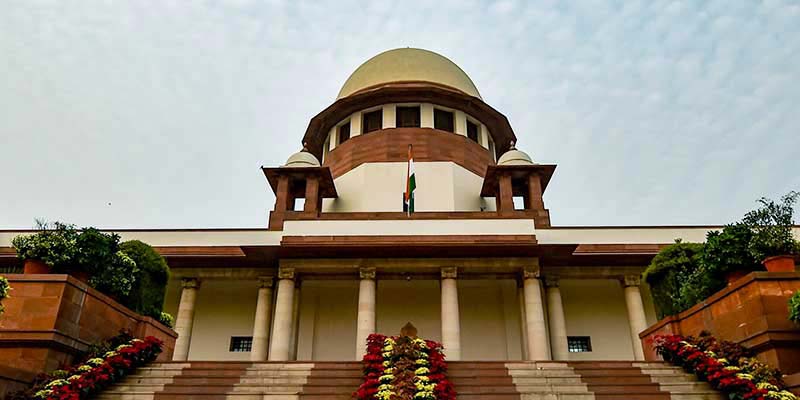
• The Supreme Court ruled that loss of wife’s domestic care should be monetised at a minimum of Rs 30,000 per month.
• A bench of Justices Sanjoy Karol and N.K. Singh passed the order while giving additional compensation to a man for the loss of his wife in a motor vehicle accident case.
• The bench observed that homemakers should be recognised as “nation builders”.
What was the case about?
• The Supreme Court’s judgment came on an appeal relating to a motor accident claim in Punjab, where a woman died in a road accident on November 25, 2001.
• The husband and three children of the deceased approached the Motor Accident Claims Tribunal seeking compensation, which granted them Rs 2.42 lakh.
• Being aggrieved, the claimants approached the High Court seeking enhancement of the amount.
• The High Court enhanced the compensation to Rs 8.43 lakh along with 7.5 per cent interest.
• Still dissatisfied, the claimants approached the Supreme Court.
The role of homemakers in building society
• According to the SC bench, it is ironic to describe a homemaker as dependent on earning members, when, in reality, the household’s functioning depends substantially on the homemaker.
• Economist Sir Cecil Pigou, in his work ‘The Economics of Welfare’ observed that “the services rendered by women enter into the dividend when they are rendered in exchange for wages, whether in the factory or in the home, but do not enter into it when they are rendered by mothers and wives gratuitously to their own families. Thus, if a man marries his housekeeper or his cook, the national dividend is diminished”.
• In 2019, the Time Use Survey highlighted the extent of unpaid domestic and caregiving work, particularly undertaken by women. Women aged between 15-59 years spend over seven hours daily on unpaid domestic tasks, compared to less than three hours by men.
• On an average, women perform 2.6 times more unpaid caregiving/domestic work, even when they are otherwise contributing economically.
• This one-sided scenario is probably one of the reasons why the
country has low female labour force participation at 31.7 per cent, since the societal framework generally presumes such responsibilities to be automatically falling upon women.
• Women’s unpaid caregiving work is estimated to contribute 15-17 per cent of India’s GDP, yet it remains unpaid and unrecognised.
• There has been a shift in sensibilities. A married woman who takes care of the house is no longer called a “housewife” and has now been elevated to the deserved status of “homemaker” in recognition of the multitudes of facets that her presence in the home covers.
• The Supreme Court, in its recent handbook on combating gender stereotypes, stated that the use of the term ‘housewife’ would be incorrect and instead the word ‘homemaker’ should be used.
• Women who are homemakers perform unpaid domestic labour (such as cooking, cleaning, washing, household management and accounts) and care work (such as caring for the elderly and for children, helping children with their homework and extracurriculars).
• The unpaid labour performed by women not only contributes to the household’s quality of life but also results in monetary savings.
• Women who are homemakers contribute to the household to an equal (or greater) extent.
• Apart from the fact that contribution of women to the society extends far beyond biological reproduction, they are also largely responsible for the preparation of human capital.
• It is often said that a mother is the first teacher that a child has. This teaching however is not like a school or a college, that has a definite end date and instead continues for the entire lives of both the mother and the child.
• Whatever positive act is undertaken by the child such as learning a skill, a language, a trade or a profession, is informed by the training that is given on the daily, by the mother.
• Human relations, which are the cornerstone of society, are perceived and understood first and foremost through the ways exemplified by conduct of the mother.
• The everyday nudging and signalling towards proper behaviour etiquette, later forms the path which the said child would then emulate for their future generations.
• The economic, emotional or psychological aspects have a direct relation to creating a healthy society and in turn towards national development and are areas of intense study in the subjects of public health and social policy.
• They are responsible for laying the foundation stones on which the edifices of the high flying business persons, successful politicians, headlining artists, sought after lawyers etc.
• The homemakers actually are the nation builders and they ought to be recognised as such, observed the Supreme Court.
• It may be a matter of deep seeded gender stereotypes that when we think of the word ‘homemaker’ the picture that emerges is that of a woman. This however may not be appropriate in all cases. As a result on one circumstance or another, sometimes unfortunate sometimes not, a man may too need to don the role of a homemaker.