
- India
- Jun 15
- Sreesha V.M
India, France launch ATL Bridge
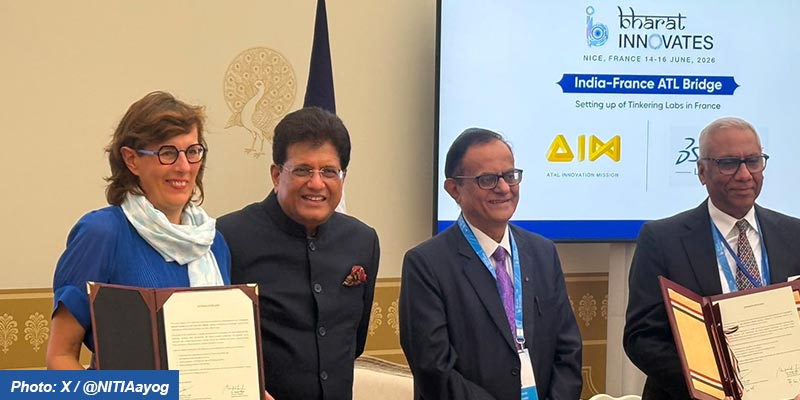
• NITI Aayog’s Atal Innovation Mission (AIM) and La Fondation Dassault Systemes established the India-France ATL Bridge to enable collaboration among young innovators in both countries.
• The initiative establishes the first School Innovation Lab in France, inspired by India’s Atal Tinkering Lab (ATL) framework, creating a structured platform for young learners to collaborate, strengthen linkages between innovation ecosystems, and deepen bilateral innovation cooperation between the two countries.
The scope of India-France ATL Bridge
• The India-France ATL Bridge will serve as a strategic platform for fostering cross-border innovation programmes, entrepreneurial exchanges, and deeper collaboration between the innovation ecosystems of India and France.
• Through knowledge exchange, capacity building, and joint innovation activities, the ATL Bridge will enable young innovators to co-create solutions to real-world challenges and strengthen early-stage innovation capabilities.
• By strengthening connections among young innovators, educators, and stakeholders, the initiative aims to further cultivate a vibrant culture of innovation and drive mutually beneficial partnerships between India and France.
What is Atal Innovation Mission (AIM)?
• Atal Innovation Mission (AIM), set up in 2016, is the government’s flagship initiative to foster innovation and entrepreneurship in schools, colleges and society at large and promote a culture of innovation and entrepreneurship in the country.
• On November 25, 2024, the Union Cabinet approved the continuation of Atal Innovation Mission, with an enhanced scope of work and an allocated budget of Rs 2,750 crore for the period till March 31, 2028.
• AIM has taken a holistic approach to ensure creation of a problem-solving innovative mindset in schools and creating an ecosystem of entrepreneurship in universities, research institutions, private and MSME sector.
• Through various programmes and policies AIM fosters innovation in different sectors of the economy, providing stakeholders with platforms and collaboration opportunities with the objective of strengthening the innovation ecosystem in the country.
Some of the major programmes under AIM include:
i) Establishment of Atal Tinkering Labs (ATL) in schools to create a problem-solving mindset in students between Classes 6-12. ATL is a flagship initiative of AIM to nurture an innovative mindset amongst high school students in India.
ii) Establishment of Atal Incubation Centres (AICs) in universities, institutions, and the private sector to foster world-class startups, as well as adding new dimensions of outcome-based scale-up and monitoring of existing incubator models.
iii) Establishment of Atal Community Innovation Centres (ACICs) in the unserved/underserved regions of the country, including tier-2 and tier-3 cities and in the hinterland, to stimulate community-centric innovations and create local hubs of innovation and job creation.
iv) Launch of Atal New India Challenges (ANICs) to foster product and service innovations in the country with national socio-economic impact and aligning them to the sectoral needs of various ministries/industry and with the Sustainable Development Goals.
v) AIM Ecosystem Development (AEDP) program was initiated with a vision to build collaborations, create strategic programs, develop the innovation ecosystem and link all parts of the AIM ecosystem.
Objectives of ATL:
i) To create workspaces where young minds can learn innovation skills, sculpt ideas through hands-on activities, work and learn in a flexible environment.
ii) To empower our youth with the 21st century skills of creativity, innovation, critical thinking, design thinking, social and cross-cultural collaboration, ethical leadership and so on.
iii) To help build innovative solutions for India’s unique problems and thereby support India’s efforts to grow as a knowledge economy.
(The author is a trainer for Civil Services aspirants.)