
- India
- Jun 16
- Sreesha V.M
BRICS adopts ‘Indore Declaration’
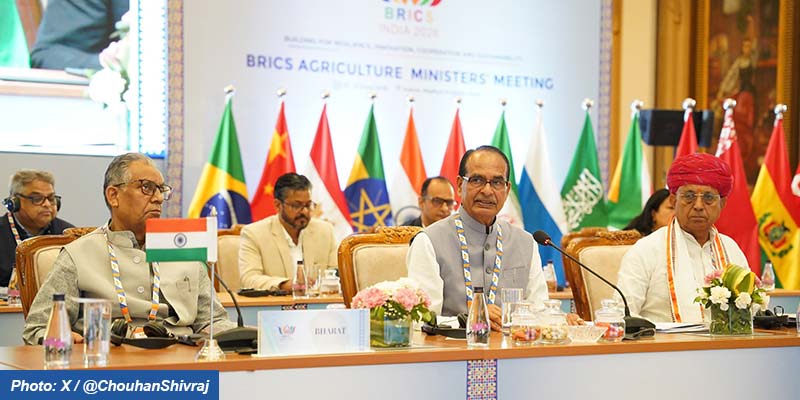
• The BRICS Agriculture Ministers’ Meeting held in Indore concluded on June 13.
• Agriculture ministers and officials of the BRICS nations participated in the meeting.
• The declaration outlines several landmark decisions aimed at strengthening food security, farmer welfare, climate-resilient agriculture, agricultural trade and digital agriculture.
• Union Minister for Agriculture & Farmers Welfare Shivraj Singh Chouhan noted that BRICS countries represent nearly half of the world's population, possess around 42 per cent of global agricultural land, and contribute approximately 42 per cent of global foodgrain production.
The BRICS Agriculture Working Group extensively discussed four priorities:
1) Food security, nutrition and livelihoods.
2) Agriculture trade and cooperation.
3) Regenerative farming, climate resilient and sustainable agriculture.
4) Strengthening partnership for innovation and investments for making the agriculture and food system future-ready.
Four new institutional initiatives
1) BRICS Network of Centres of Excellence on Agro-Ecology and Regenerative Agriculture
Union Minister Chouhan announced the establishment of the BRICS Network of Centres of Excellence on AgroEcology and Regenerative Agriculture. The network would serve as a platform for joint research, knowledge sharing and capacity building in natural, organic and regenerative agriculture, enabling member countries to learn from each other's best practices and promote climate-resilient and sustainable farming systems. Indian Institute of Farming Systems Research, Modipuram, would play a key role as India’s Centre of Excellence under the network and contribute to collaborative research, knowledge sharing and training.
2) BRICS Network on Digital Agriculture
The second major initiative announced was the BRICS Network on Digital Agriculture. The network would strengthen cooperation in artificial intelligence, geospatial technologies, digital public infrastructure and data-driven agricultural solutions. The initiative would act as a bridge between emerging technologies and agricultural innovation, ensuring that technological advancements directly benefit farmers. The network will be coordinated by IIT-Delhi, while all member countries will contribute by sharing innovations, experiences and policy initiatives to ensure collective progress in digital agriculture.
3) Global Forum on Farmers’ Rights in Seed Systems
The third major announcement was the establishment of the Global Forum on Farmers’ Rights in Seed Systems. The forum will focus on protecting farmers' rights related to seeds, conserving indigenous seed diversity and preserving traditional knowledge systems. The forum will work towards ensuring the conservation and continued availability of traditional seeds, recognising their importance in the context of climate change and food security, and safeguarding farmers’ traditional knowledge.
4) BRICS AgriN - Agro Inputs, Genetic Resources and Information Network
The fourth initiative announced was BRICS AgriN (Agro Inputs, Genetic Resources and Information Network). The platform aims to strengthen cooperation among member countries in agricultural inputs, seeds and genetic resources. The network would facilitate information exchange, technical cooperation, capacity building and partnerships so that superior varieties, genetic resources and best practices available in different countries could be shared more effectively. The initiative would particularly benefit countries and farmers with limited access to such resources and information.
(The author is a trainer for Civil Services aspirants.)