
- India
- Jun 23
- Sreesha V.M
Jitendra Singh launches ‘IAS e-Civil List 2026’
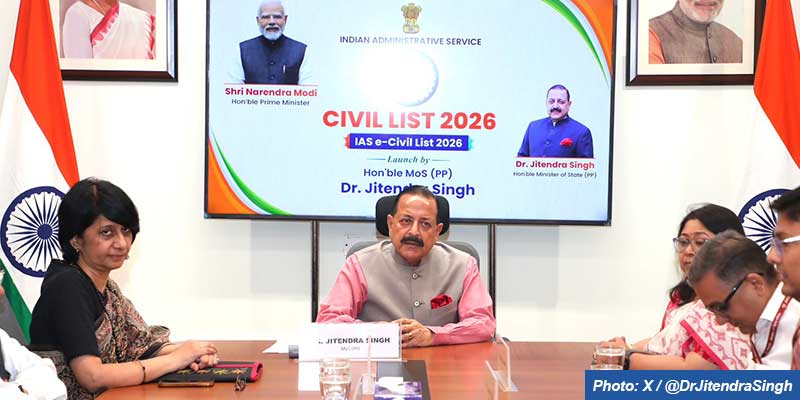
• Union Minister Jitendra Singh launched the IAS e-Civil List 2026 at Kartavya Bhawan, New Delhi on June 22.
• The minister reviewed the cadre strength position of the Indian Administrative Service and discussed the evolving manpower requirements of states and the Centre.
What is e-Civil List?
• Digital platforms such as the e-Civil List have emerged as important instruments for administrative planning, talent identification and effective deployment of human resources across the country.
• Easy access to information relating to officers’ qualifications, experience, cadre and postings enables governments and institutions to make informed decisions and strengthens the overall governance framework.
• Equipped with advanced search facilities and hyperlinking features, it enables quick and convenient access to information at the click of a button.
• The Civil List has evolved beyond being a mere directory of officers and today serves as a dynamic knowledge resource for governments, institutions and stakeholders.
• The digital format allows users to identify officers based on professional background, domain expertise and experience, thereby facilitating better administrative planning and policy implementation.
• It also provides information regarding cadre-wise strength, the number of officers retiring during the next five years, and the number of IAS officers appointed through the Civil Services Examination from 1969 onwards.
• The publication of the e-book has enabled the Department of Personnel and Training to move away from the traditional practice of printing voluminous physical copies of the Civil List.
• The Department of Personnel and Training, which is the cadre controlling authority for the Indian Administrative Service, prepares the Civil List using inputs received from state cadres as well as information available at the Centre.
(The author is a trainer for Civil Services aspirants.)