
- India
- Jun 24
New Delhi hosts 16th BRICS NSAs meeting
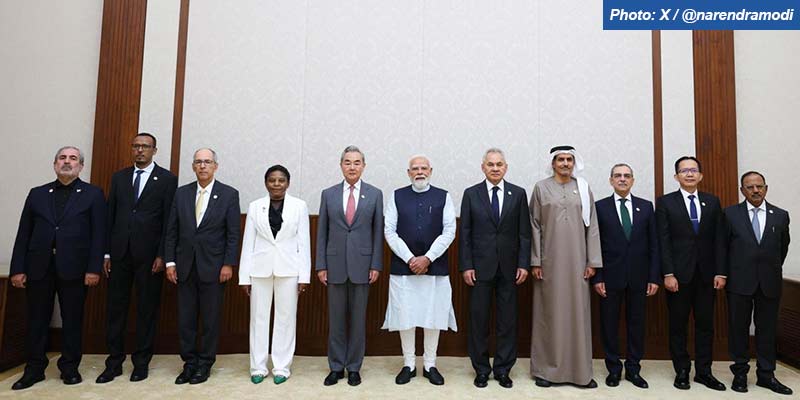
• The 16th BRICS National Security Advisers’ Meeting was held on June 22 and 23 in New Delhi.
• BRICS, originally comprising Brazil, Russia, India, China, and South Africa, expanded in 2024 to include Egypt, Ethiopia, Iran, and the United Arab Emirates, with Indonesia joining in 2025.
• The meeting was chaired by India’s National Security Adviser (NSA) Ajit Doval.
• India welcomed the US-Iran Memorandum of Understanding (MoU) on ending hostilities in West Asia.
• The opening of the Strait of Hormuz is a very welcome move for global energy security, Doval said, addressing the meeting.
• During the meeting, the NSAs/heads of delegation of BRICS Member Countries exchanged views on the theme ‘non-traditional security challenges confronting the world today’.
• In the non-traditional realm, they deliberated on challenges related to energy security, food security, supply chain security, emerging technologies utilised by terrorist networks, cyber security and climate-induced instability.
• They also reviewed the activities and outcomes of the BRICS Joint Working Groups on Counter-Terrorism held on May 21-22.
• They reaffirmed their commitment to combating terrorism in all its forms and manifestations, including through countering the use of new technologies being utilized by them.
• After the conclusion of the meeting, they jointly called on Prime Minister Narendra Modi.
• PM Modi highlighted the growing significance of the grouping in addressing contemporary global security challenges.
The BRICS nations
• The BRICS nations or Brazil, Russia, India, China and South Africa form the key pillars of south-south cooperation and are the representative voice of emerging markets and developing countries in the global forums such as the G20.
• The grouping has become a 11-nation body now with Egypt, Ethiopia, Iran, Saudi Arabia, the United Arab Emirates and Indonesia joining it as new members.
• The acronym BRIC was first used in 2001 by Goldman Sachs in their Global Economics Paper, ‘The World Needs Better Economic BRICs’ on the basis of econometric analyses projecting that the four economies would individually and collectively occupy far greater economic space and would be amongst the world’s largest economies in the next 50 years or so.
• The leaders of BRIC (Brazil, Russia, India, and China) countries met for the first time in St. Petersburg, Russia, on the margins of the G8 Outreach Summit in July 2006. Shortly afterwards, in September 2006, the group was formalised as BRIC during the First BRIC Foreign Ministers’ Meeting, which met on the sidelines of the General Debate of the UN Assembly in New York City.
• After a series of high level meetings, the first BRIC summit was held in Yekaterinburg, Russia on June 16, 2009.
• It was agreed to expand BRIC into BRICS with the inclusion of South Africa at the BRIC Foreign Ministers meeting in New York in September 2010. Accordingly, South Africa attended the third BRICS Summit in Sanya on April 14, 2011.
• In 2015, the BRICS established the New Development Bank (NDB) with the purpose of mobilising resources for infrastructure and sustainable development projects in emerging markets and developing countries.
Expansion of BRICS
• BRICS leaders have left the door open to future enlargement as dozens more countries voiced interest in joining a grouping.
• Around 40 countries had shown interest in joining BRICS out of which 23 formally applied for the membership.
• In August 2023, the top BRICS leaders at the grouping’s summit in Johannesburg approved a proposal to admit six countries, including Argentina, into the bloc with effect from January 1, 2024. However, Argentina’s President Javier Milei announced withdrawing his country from becoming a member of the BRICS.
• The decision to expand the bloc is seen as an effort to reshape global governance while putting the voices of the Global South as a key priority area to advance the overall development agenda.
• The BRICS has emerged as an influential grouping as it brings together 11 major emerging economies of the world, representing around 49.5 per cent of the global population, around 40 per cent of the global GDP and around 26 per cent of the global trade.