
- India
- Jun 24
President Murmu confers 65 Padma awards
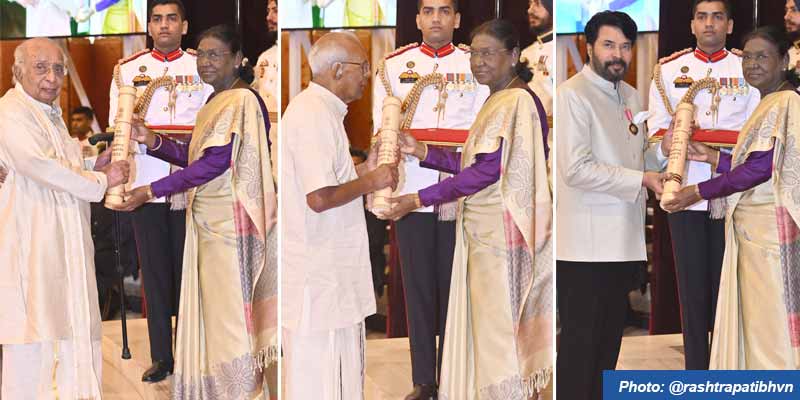
• President Droupadi Murmu presented 65 Padma Awards for the year 2026 in the second civil investiture ceremony at the Ganatantra Mandap of Rashtrapati Bhavan on June 23.
• For 2026, the President has approved conferment of 131 Padma awards — five Padma Vibhushan, 13 Padma Bhushan and 113 Padma Shri.
• At the first civil investiture ceremony on May 25, she conferred two Padma Vibhushan, six Padma Bhushan and 58 Padma Shri awards.
• The President presented Padma Vibhushan to former Supreme Court judge Justice (retd) K.T. Thomas for public affairs and eminent Malayalam journalist P. Narayanan for contribution in literature and education.
• Playback singer Alka Yagnik, Malayalam actor Mammootty, American oncologist Dattatreyudu Nori, tennis player Vijay Amritraj, industrialist S.K.M. Maeilanandhan and social worker and educationist Vellappally Natesan received Padma Bhushan from the president during the ceremony.
• Rupi Soren, wife of JMM founder Shibu Soren, received the Padma Bhushan on behalf of the late leader.
• The President conferred Padma Shri to cricketer Rohit Sharma, who led India to victory in the last T20 World Cup, and hockey player Savita Punia.
• The President also conferred Padma Shri to actor Satish Shah posthumously.
Padma Awards
• The Padma Awards are one of the highest civilian honours of India announced annually on the eve of Republic Day.
The awards are given in three categories:
i) Padma Vibhushan (for exceptional and distinguished service).
ii) Padma Bhushan (distinguished service of higher order).
iii) Padma Shri (distinguished service).
• The award seeks to recognise achievements in all fields of activities or disciplines where an element of public service is involved.
• The Padma Awards are conferred on the recommendations made by the Padma Awards Committee, which is constituted by the Prime Minister every year. The nomination process is open to the public. Even self-nomination can be made.
When were the awards instituted?
• The government instituted two civilian awards — Bharat Ratna and Padma Vibhushan in 1954.
• Padma Vibhushan had three classes namely Pahela Varg, Dusra Varg and Tisra Varg. These were subsequently renamed as Padma Vibhushan, Padma Bhushan and Padma Shri.
• The award seeks to recognise works of distinction and is given for distinguished and exceptional achievements / service in all fields of activities / disciplines.
The fields include:
i) Art (includes music, painting, sculpture, photography, cinema and theatre).
ii) Social Work (includes social service, charitable service and community projects).
iii) Public Affairs (includes law, public life and politics).
iv) Science & Engineering (includes space engineering, nuclear science, information technology and research & development).
v) Trade & Industry (includes banking, economic activities, management, promotion of tourism and business).
vi) Medicine (includes medical research, distinction / specialisation in Ayurveda, Homeopathy, Siddha, Allopathy and Naturopathy).
vii) Literature & Education (includes journalism, teaching, book composing, literature, poetry, promotion of education and literacy, and education reforms).
viii) Civil Service (includes distinction / excellence in administration by government servants).
ix) Sports (includes popular sports, adventure, mountaineering and yoga).
x) Others (fields not covered above and may include propagation of Indian culture, protection of human rights, wildlife protection and conservation).
• The award is normally not conferred posthumously. However, in highly deserving cases, the government could consider giving an award posthumously.
• A higher category of Padma award can be conferred on a person only where a period of at least five years has elapsed since conferment of the earlier Padma award. However, in highly deserving cases, a relaxation can be made by the Awards Committee.
• The award does not amount to a title and cannot be used as a suffix or prefix to the awardees’ name.