
- India
- Jun 24
Italy brings Sandro Botticelli's iconic painting to India
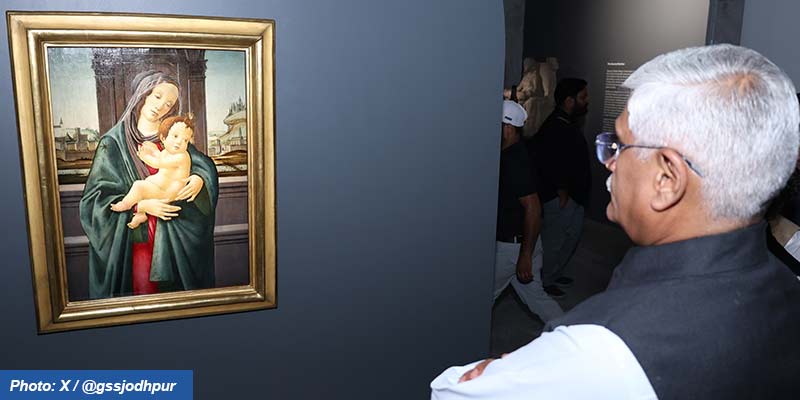
• Italian Renaissance master Sandro Botticelli’s iconic painting ‘Madonna and Child’, is being exhibited in India for the first time at an exhibition in New Delhi.
• Union Minister of Culture and Tourism Gajendra Singh Shekhawat participated in the inauguration of the exhibition named ‘One Mother, Many Mother Tongues’ organised by the Italian Embassy Cultural Centre at the Humayun’s Tomb Museum in New Delhi.
• There are 27 objects on display, sourced from multiple museums in the two countries, as well as three private collections, all co-curated by Andrea Anastasio, Director of the Italian Embassy Cultural Centre, and Namun Ahuja, professor of art history at the Jawaharlal Nehru University (JNU), Delhi.
• The exhibition explores the enduring image of the mother and child — one of human history’s most universal visual narratives.
• The Italian pieces also include the iconic statue of ‘Mater Matuta’.
• ‘Mater Matuta’, produced in central Italy between the 6th and 3rd centuries BCE, presents an intimate image of motherhood.
• The exhibition, which connects the cultural heritage of India and Italy, establishes a dialogue beyond the boundaries of time and geography.
• It offers the opportunity to view ancient Indian sculptures alongside Italy’s renowned artworks and historical symbols associated with motherhood.
Who was Sandro Botticelli?
• Alessandro di Mariano di Vanni Filipepi, popularly known as Sandro Botticelli, was born in 1445 in Italy’s Florence.
• He was one of the major painters of the Italian Renaissance.
• He was given the nickname Botticelli, derived from the word ‘botticello’ meaning “small wine cask”.
• He created one of the most famous paintings in the history of art in 1486, the ‘Birth of Venus’.
• His iconic works include ‘Primavera’ and the ‘Cestello Annunciation’.
• In addition to his religious portraits and paintings, Sandro Botticelli left behind a remarkable catalogue of drawings, including those designed to illustrate Dante’s ‘Divine Comedy’.
• Botticelli passed away on May 17, 1510.