
- India
- Jun 25
- Sreesha V.M
Jitendra Singh pitches for ‘BRICS Space Economy’
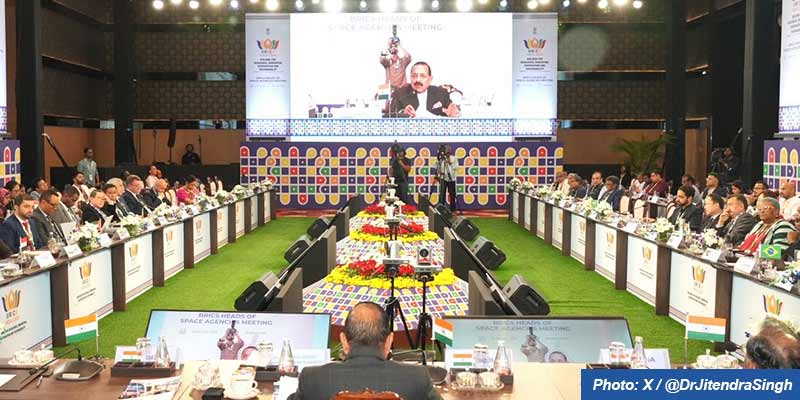
• Union Minister Jitendra Singh pitched the ‘BRICS Space Economy’ as the next frontier of global growth and called for collective action among member nations to unlock opportunities in innovation, investment, entrepreneurship and sustainable development.
• Hosted by ISRO under India’s BRICS Chairship in 2026, the two-day meeting brought together heads of space agencies and senior officials from Brazil, China, Egypt, Ethiopia, Indonesia, Iran, Russia, South Africa and the United Arab Emirates.
• The meeting reviewed progress in BRICS space cooperation and deliberated on key issues, such as space sustainability, debris-free missions, strengthening the BRICS Remote Sensing Satellite Constellation (RSSC), expanding the participation of new BRICS members in existing cooperation mechanisms, and advancing discussions on the proposed BRICS Space Council.
• Deliberations covered future collaboration in disaster management, Earth observation, capacity building and knowledge sharing.
• BRICS, originally comprising Brazil, Russia, India, China, and South Africa, expanded in 2024 to include Egypt, Ethiopia, Iran, and the United Arab Emirates, with Indonesia joining in 2025.
Scope of BRICS Space Economy
• Space technology has emerged as one of the most powerful drivers of economic transformation and societal progress, enabling countries to strengthen communication networks, navigation systems, disaster preparedness, agriculture, healthcare, education and environmental monitoring.
• Challenges such as climate change, natural disasters, food and water security, environmental degradation and sustainable urbanisation increasingly require collective solutions supported by advanced space technologies.
• The BRICS grouping represents a significant share of the world’s population, economic output, scientific expertise and technological capabilities.
• Deeper cooperation among BRICS countries can create new opportunities for innovation, industrial partnerships, technology transfer, investment and economic growth while addressing common developmental priorities.
• BRICS countries possess the scale, scientific expertise, technological strengths and industrial capacity needed to emerge as a major force in the rapidly expanding global space economy.
• The future of the space economy will not be shaped by nations working in isolation. It will be shaped by partnerships, shared innovation and collective ambition.
• BRICS countries have the potential to become one of the strongest pillars of this emerging global space ecosystem.
• The BRICS Remote Sensing Satellite Constellation has already demonstrated the value of collaborative space applications through satellite data sharing among member countries.
• Ongoing discussions on institutional mechanisms, including the proposed BRICS Space Council, would provide greater momentum and continuity to future cooperation in the space sector.
(The author is a trainer for Civil Services aspirants.)