
- India
- Jun 27
Govt releases names of six soldiers killed during ‘Operation Sindoor’
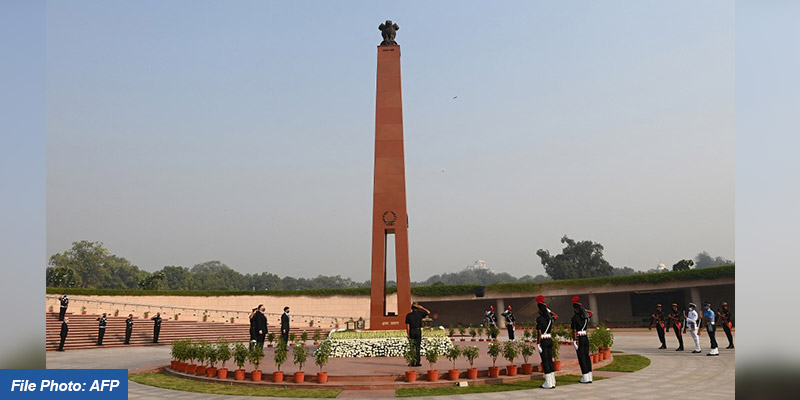
• The names of six military personnel who died in the line of duty during Operation Sindoor in May 2025 have been inscribed on a wall at the National War Memorial.
• This is the first time since the military operation that the government has released the names of these six personnel.
• The names of the six personnel are inscribed on wall no. 3D of Tyag Chakra at the National War Memorial.
• They are: Subedar Major Pawan Kumar, Rifleman Sunil Kumar (VrC), Lance Naik Dinesh Kumar, Agniveer Mood Muralinaik, Havildar Sunil Kumar Singh from the Army, and Indian Air Force’s Sergeant Surendra Kumar.
• The unit names of these bravehearts have also been inscribed.
• These names have also been added to the Roll of Honour on the website of the National War Memorial.
Operation Sindoor
• On April 22, 2025 as many as 26 people, mostly tourists, were killed in a terrorist attack in Kashmir’s Pahalgam.
• In retaliation to the terrorist attack, Indian armed forces launched ‘Operation Sindoor’ on May 7, 2025.
• Indian armed forces carried out missile strikes on nine targets in Pakistan and Pakistan-Occupied Kashmir (PoK).
• Indian forces targeted the headquarters of the banned Jaish-e-Mohammed (JeM) and Lashkar-e-Taiba (LeT) groups in the missile attacks.
• Among the nine sites targeted are the JeM headquarters in Bahawalpur and the LeT’s in Muridke, both in Pakistan’s Punjab.
• Pakistan also launched offensives against India. Pakistan attempted targeting Indian civilian areas, in addition to some military facilities. These provocations and escalatory actions by Pakistan were met with a strong and decisive response from the Indian armed forces.
• On May 10, 2025, the Director General of Military Operations (DGMO) of Pakistan approached his Indian counterpart to request for cessation of firing and military activities, which was agreed to later that day.
National War Memorial
• Built at a cost of Rs 176 crore, the main structure of the memorial is a 15.5-m obelisk, an eternal flame and six bronze murals depicting famous battles fought by the Indian Army, Air Force and the Navy in a covered gallery.
• In the complex, 16 walls have been constructed for paying homage to the battle casualties and their names have been inscribed on granite tablets arranged in a circular pattern, symbolising the ancient Indian war formation Chakravyuh.
• The NWM pays tribute to soldiers who laid down their lives defending the nation during the India-China War in 1962, Indo-Pak Wars in 1947, 1965 and 1971 and the Kargil conflict of 1999. It also commemorates the soldiers who participated and made supreme sacrifice in UN Peacekeeping Missions, during Humanitarian Assistance and Disaster Relief (HADR) Operations, counter-insurgency operations and Low-Intensity Capital Operations (LICO).
• The memorial has a layout comprising four concentric circles, namely the Amar Chakra (Circle of Immortality), Veerta Chakra (Circle of Bravery), Tyag Chakra (Circle of Sacrifice) and Rakshak Chakra (Circle of Protection).
• The outermost circle — Rakshak Chakra — comprises rows of more than 600 trees with each tree representing many soldiers who guard the territorial integrity of the nation round the clock.
• The memorial complex also comprises graphic panels and stone murals. Busts of the 21 awardees of Param Vir Chakra — India’s highest military honour — have been installed at Param Yodha Sthal.