
- India
- Jun 27
ISRO appoints U.P. Rajeev as new VSSC director
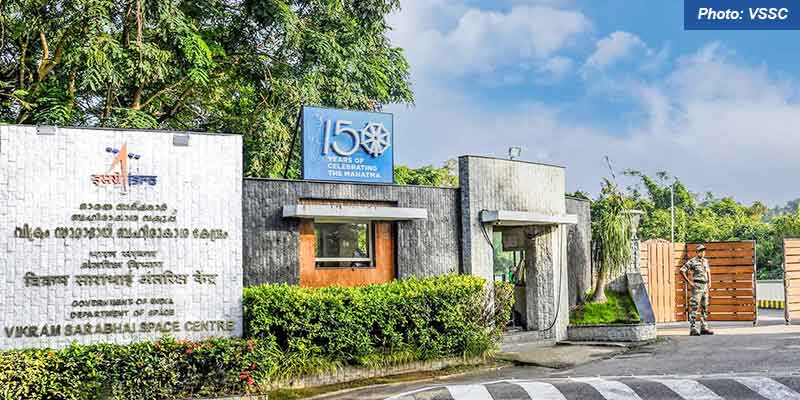
• Senior scientist U.P Rajeev has been appointed as the new director of the Vikram Sarabhai Space Centre (VSSC) in Thiruvananthapuram.
• Rajeev is currently serving as associate director (research and development) at VSSC.
• With decades of experience in rocket control and guidance systems, he has played a leading role in the mission design and simulation of several of ISRO’s major launch vehicle programmes.
• An alumnus of the College of Engineering Thiruvananthapuram, where he earned a degree in Applied Electronics and Instrumentation, Rajeev later completed his postgraduate studies in Instrumentation and Control Systems at the National Institute of Technology, Calicut.
• He subsequently obtained a PhD from the Indian Institute of Science before continuing his career at ISRO.
Key facts about Vikram Sarabhai Space Centre (VSSC):
• The Centre is named in memory of Dr Vikram A. Sarabhai, who is known as “the father of Indian space programme”.
• VSSC pioneers in rocket research and launch vehicle projects of ISRO.
• It is mainly responsible for the design and development of space transportation systems and associated technologies.
• Major programmes at VSSC include Gaganyaan, Polar Satellite Launch Vehicle (PSLV), Geosynchronous Satellite Launch Vehicle (GSLV), Launch Vehicle MkIII (LVM3), Small Satellite Launch Vehicle (SSLV), winged Reusable Launch Vehicle (RLV), Rohini Sounding Rockets as well as development of various technologies for future.
• PSLV, GSLV, LVM3 and SSLV are in operational phase.
• The Centre has been leading the development of ISRO’s Next Generation Launch Vehicle (NGLV) as well as the development of critical systems related to Gaganyaan including Human rated HLVM3, design of Crew Module, parachute systems, Crew Escape System and mission design.
• VSSC has core competence in multiple disciplines and pursues advanced research & development in cutting edge technologies for space transportation systems, its overall project management, technology transfer, academic interface and enabling space industry ecosystem.
Origin of VSSC
• VSSC had a small beginning at Thumba, a coastal village in Thiruvananthapuram in 1962.
• In the early 1960s, the Indian National Committee on Space Research (INCOSPAR), the Indian counterpart of the Committee for Space Research (COSPAR) of the UN, was formed under the leadership of Vikram A. Sarabhai.
• The Thumba Equatorial Rocket Launch Station (TERLS) was established in 1962 for this purpose under UN sponsorship.
• On November 21, 1963, a two-stage sounding rocket, Nike-Apache, was launched from TERLS, marking the beginning of space exploration in India.
• Recognising the special value of this unique facility slightly off the magnetic equator, Prime Minister Indira Gandhi dedicated TERLS to the UN on February 2, 1968.
• With this, there was a quantum jump in the scope for research in aeronomy and atmospheric sciences in India. In due course, the US, USSR, Japan, France and Germany started launching sounding rockets from TERLS.
• In 1969, the Indian Space Research Organisation (ISRO) was formed under the Department of Atomic Energy to coordinate and conduct space research in the country.
• In 1970, the Hydrometeorological Services of the USSR signed an agreement with ISRO to launch their meteorological sounding rockets, M-100, every week, from TERLS. This programme continued uninterruptedly until 1993. Besides these, India launched a series of its own sounding rockets named Rohini from TERLS.
• In July 1972, TERLS came under the umbrella of VSSC.
• In due course, TERLS was unable to support the increasing frequency of rocket launches. On account of insufficient space in Thumba and the limitations of space imposed by range safety considerations, a second rocket launching station was established on the east coast at Sriharikota island in Andhra Pradesh. This station named SHAR (or the Sriharikota Range) is now the space port of India.