
- India
- Jun 29
India’s rank rises to 94 in SDG Index
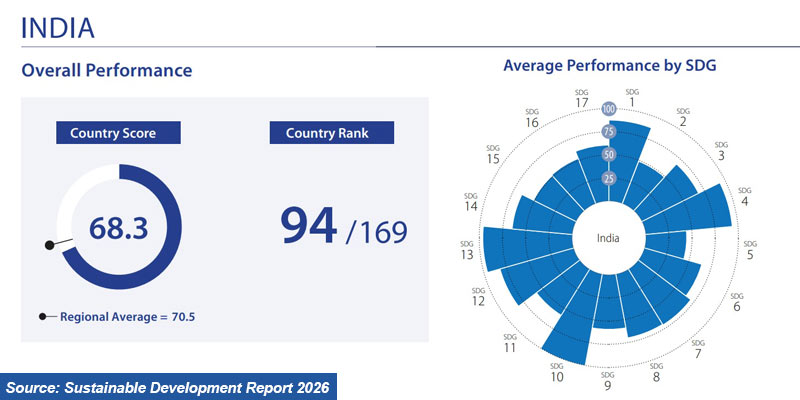
• India’s rank improved to 94 among 169 countries in Sustainable Development Goals (SDG) Index this year.
• The Sustainable Development Report (formerly the SDG Index & Dashboards) is a global assessment of countries’ progress towards achieving the Sustainable Development Goals.
• It is a complement to the official SDG indicators and the voluntary national reviews.
• In 2025, the country was at 99th place in the Index and at 109th position in 2024.
• The score measures progress on a scale of 0 to 100 where 100 indicates a country has achieved all 17 goals and 0 means no progress has been made.
• European countries, especially the Nordic nations, continue to top the SDG Index, with Finland ranking first, Sweden second and Denmark third.
• Finland has a score of 87.40.
Sustainable Development Goals (SDGs)
• The Sustainable Development Goals (SDGs) were adopted by all UN member states in 2015 as a universal call of action to end poverty, protect the planet and ensure that all people enjoy peace and prosperity by 2030.
• Also known as the Global Goals, the SDGs are a call to action to create a world where no one is left behind.
• It consists of 17 goals and 169 targets.
• The SDGs are the blueprint to achieve a better and more sustainable future for all. They address the global challenges we face.
• The SDGs are a call for action by all countries – poor, rich and middle-income – to promote prosperity while protecting the planet.
• They recognise that ending poverty must go hand-in-hand with strategies that build economic growth and address a range of social needs including education, health, social protection, and job opportunities, while tackling climate change and environmental protection.
The 17 SDGs are:
1) No poverty: End poverty in all its forms, everywhere.
2) Zero hunger: End hunger, achieve food security and improved nutrition, and promote sustainable agriculture.
3) Good health and well-being: Ensure healthy lives and promote well-being for all, at all ages.
4) Quality education: Ensure inclusive and equitable quality education and promote lifelong learning opportunities for all.
5) Gender equality: Achieve gender equality and empower all women and girls.
6) Clean water and sanitation: Ensure availability and sustainable management of water and sanitation for all.
7) Affordable and clean energy: Ensure access to affordable, reliable, sustainable and modern energy for all.
8) Decent work and economic growth: Promote inclusive and sustainable economic growth, full and productive employment, and decent work for all.
9) Industry, innovation and infrastructure: Build resilient infrastructure, promote inclusive and sustainable industrialization and foster innovation.
10) Reduced inequalities: Reduce inequality within and among countries.
11) Sustainable cities and communities: Make cities and human settlements inclusive, safe, resilient and sustainable.
12) Responsible consumption and production: Ensure sustainable consumption and production patterns.
13) Climate action: Take urgent action to combat climate change and its impacts.
14) Life below water: Conserve and sustainably use the oceans, seas and marine resources for sustainable development.
15) Life on land: Protect, restore and promote sustainable use of terrestrial ecosystems, sustainably manage forests, combat desertification, halt and reverse land degradation, and halt biodiversity loss.
16) Peace, justice and strong institutions: Promote peaceful and inclusive societies for sustainable development, provide access to justice for all, and build effective, accountable and inclusive institutions at all levels.
17) Partnerships for the goals: Strengthen the means of implementation and revitalise the global partnership for sustainable development.