
- India
- Jul 01
- Sreesha V.M
India launches UPI in Greece
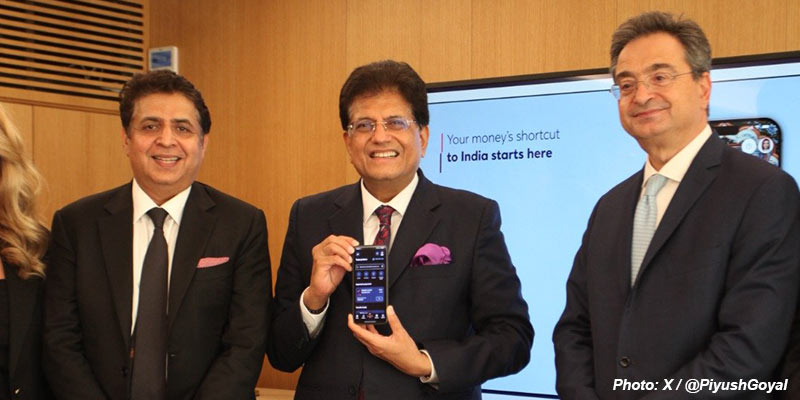
• India launched the Unified Payments Interface (UPI) in Greece, marking another milestone in the global expansion of the country’s digital payment ecosystem.
• The Union Minister of Commerce and Industry Piyush Goyal witnessed the live demonstration of the Eurobank-NIPL partnership enabling UPI services at Eurobank headquarters in Athens on June 30.
• The event demonstrated the capabilities created through Eurobank’s strategic collaboration with NPCI International Payments Limited (NIPL), a subsidiary of the National Payments Corporation of India (NPCI), to strengthen cross-border connectivity by leveraging modern digital infrastructure that facilitates transactions and enhances connectivity between the two markets.
• With UPI now live in Greece, eligible customers can transfer money instantly, securely, and seamlessly, with transaction costs reduced significantly to a fraction of those associated with conventional money transfer methods.
• UPI is now accepted in ten countries namely Greece, Singapore, the United Arab Emirates, France, Mauritius, Nepal, Bhutan, Qatar, Sri Lanka and Cambodia — enabling Indian travellers to make seamless payments abroad through familiar platforms.
What is Unified Payments Interface (UPI)?
• Before 2016, India used a number of different systems to transfer money between banks. The traditional forms included National Electronic Funds Transfer (NEFT) and Real-Time Gross Settlement (RTGS). With the plethora of systems, rules and growing paper burden, there was a need for a unified system that could automate and standardise India’s payment platforms.
• In 2016, the National Payments Corporation of India (NPCI) set out with a mandate to change the face of India’s payment systems. It developed the Unified Payments Interface (UPI) as an architecture framework with a set of standard Application Programming Interface (API) specifications to facilitate online payments.
• UPI is an instant payments platform built over the Immediate Payment Service (IMPS) infrastructure, India’s pre-existing real-time interbank electronic fund transfer service.
• The aim was to simplify and provide a single interface across all NPCI systems, thereby creating interoperability and a superior customer experience.
• The pilot programme, with 21 member banks, was launched on April 11, 2016.
• The UPI is a system that powers multiple bank accounts into a single mobile application (of any participating bank), merging several banking features, seamless fund routing and merchant payments into one hood.
• It also caters to the “peer to peer” collect request which can be scheduled and paid as per requirement and convenience.
• It facilitates immediate money transfer through mobile devices round the clock.
• A user seeking to make a payment can open an app and use that to make a transfer to a user of a different payments app. The NPCI, which runs UPI, sits in the middle and ensures that the payer’s and payee’s banks debit and credit the amount accordingly.
Growth of UPI
• UPI has transformed digital payments in India and emerged as one of the fastest-growing payment platforms globally.
• The volume of UPI transactions has increased significantly from 3,873 crore transactions in CY 2021 to 22,828 crore transactions in CY 2025. The total value of transactions grew from Rs 72 lakh crore in CY 2021 to Rs 300 lakh crore in CY 2025. The CAGR of the UPI transaction during this period is 55.8 per cent in terms of volume and 43 per cent in terms of value.
• As UPI is mainly used for small value transactions, the average ticket size of such transactions remains low. From Rs 1,848 in CY 2021, the average ticket size of UPI transactions declined further to Rs 1,313 in CY 2025.
(The author is a trainer for Civil Services aspirants.)