
- India
- Jul 03
SC quashes NCLT verdict based on AI-generated precedents
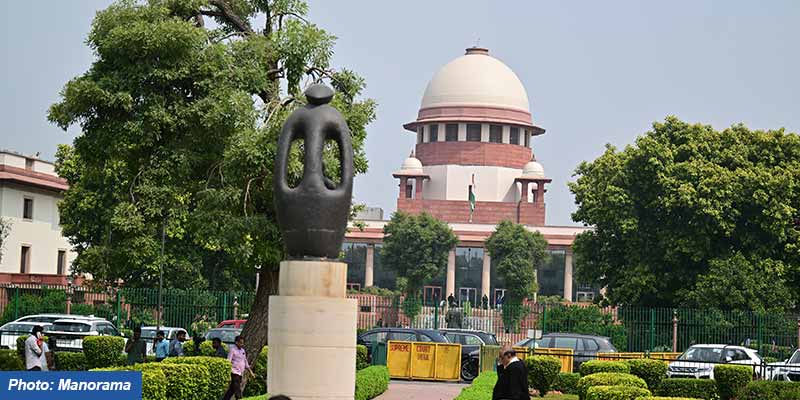
• The Supreme Court set aside a verdict of the National Company Law Tribunal (NCLT), which relied on non-existent, fake and hallucinated material, generated through artificial intelligence (AI).
• The bench comprising Justices P.S. Narasimha and Alok Aradhe said the production of fake, non-existent, and hallucinated material and its utilisation as precedents in law, is like the release of methyl isocyanate in the province of law and justice.
• The highly toxic methyl isocyanate (MIC) gas leaked from the Union Carbide pesticide factory on the intervening night of December 2-3, 1984, killing at least 5,479 persons and leaving thousands with serious and long-lasting health issues. Methyl isocyanate is used to produce carbamate pesticides.
What was the case about?
• The matter arose from an insolvency dispute involving Pooja Ramesh Singh and Jammu & Kashmir Bank Ltd and Essel Infraprojects Ltd.
• The appellant challenged an NCLT Mumbai order that had admitted a Section 7 insolvency application.
• The Supreme Court found that several “precedents” cited by the NCLT to justify its decision simply did not exist.
• These included fabricated case names and paragraphs wrongly attributed to genuine citations.
• While respondent Jammu & Kashmir Bank filed an affidavit clarifying that their counsel had not cited these cases and that the NCLT had obtained them through its “own research”, the Supreme Court held that the source of the error did not mitigate the damage to the rule of law.
What the SC said about using AI in courts?
• It is necessary for courts to adopt a zero-tolerance mode for producing, citing or using AI-generated precedents without verification.
• It is a misconduct on the part of an advocate to cite such judgments without verification.
• Equally, it is a serious lapse if a judge relies on such a fake or hallucinated AI-generated material as precedents in support of the determination.
• Such decisions are to be set aside even if an iota of fake or hallucinated material enters the decision-making process, as it would violate the sanctity of adjudication.
• It is absolutely necessary to maintain integrity in decision-making, and the Supreme Court reiterated and declared zero tolerance for the Bar as well as the Bench to cite, refer to, or rely on such material.
• The apex court clarified that the judgment shall have no bearing on the rightful use of AI, but on the presentation or reliance on fake or hallucinated material as if it were a court precedent.
• The SC bench directed the Bar Council of India, being the apex statutory body, to constitute a committee and deliberate on this issue of members of the bar submitting such fake and hallucinated material before the court as if they are precedents of law.
• The verdict said the apex bar body must take up this issue with utmost seriousness, deliberate earnestly, and prescribe a guiding principle to prevent such occurrences, along with the disciplinary action that will follow a violation of the norms.
What is National Company Law Tribunal (NCLT)?
• The National Company Law Tribunal (NCLT) is a quasi-judicial body that adjudicates issues relating to Indian companies.
• The NCLT was established under the Companies Act, 2013, and was constituted on June 1, 2016 by the Union government.
• It was based on the recommendation of the Justice Eradi Committee on law relating to insolvency and winding up of companies. All proceedings under the Companies Act, including proceedings relating to arbitration, compromise, arrangements and reconstruction and winding up of companies, shall be disposed of by the NCLT.
• It is tasked with the key job of helping recover corporate loans.
• The NCLT is the adjudicating authority for insolvency resolution process of companies and limited liability partnerships under the Insolvency and Bankruptcy Code, 2016.
• Decisions of the NCLT may be appealed at the National Company Law Appellate Tribunal (NCLAT). The NCLAT decisions can be challenged at the Supreme Court on a point of law.
• NCLT, besides a principal bench at New Delhi, has 15 other benches — Ahmedabad, Allahabad, Amravati, Bengaluru, Chandigarh, Chennai, Cuttack, Guwahati, Hyderabad, Indore, Jaipur, Kochi, Kolkata and Mumbai.