
- India
- Jul 08
ISRO conducts flight acceptance test of cryogenic engine for next LVM3 mission
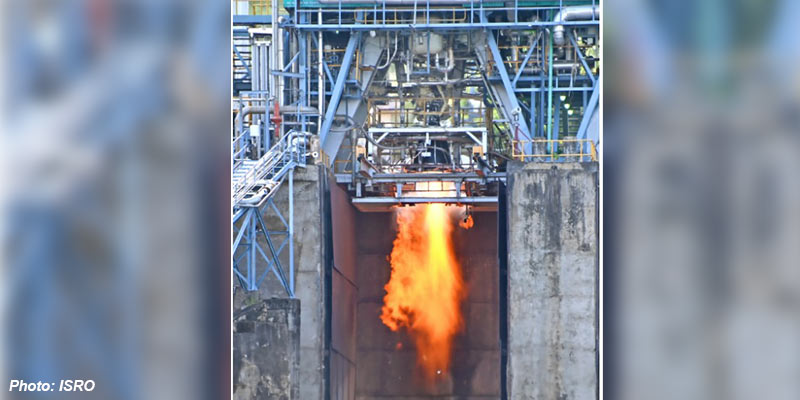
• The Indian Space Research Organisation (ISRO) successfully carried out the flight acceptance hot test of its CE20 cryogenic engine designated for the seventh operational mission of LVM3-M7.
• The test took place at the ISRO Propulsion Complex in Mahendragiri, Tamil Nadu.
• Human-rating qualification requirements were also accomplished on this engine for inducting in Gaganyaan missions.
• ISRO has renamed the Geosynchronous Satellite Launch Vehicle (GSLV) Mark-III as Launch Vehicle Mark-III, mainly to identify its task of placing satellites into a variety of orbits.
• LVM3 is the heavy lift launch vehicle of ISRO for achieving a 4,000 kg spacecraft launching capability to GTO (Geosynchronous Transfer Orbit).
• LVM3 uses the CE20 cryogenic engine to power its upper stage.
• The engine is qualified to operate at thrust levels ranging from 19 to 22 tonnes, and the engine performed successfully in eight successive LVM3 missions, including Chandrayaan-2, Chandrayaan-3 and three commercial missions.
• The upper stage of LVM3 launch vehicle is powered by indigenously developed CE20 cryogenic engine.
• In the latest flight acceptance hot test, the CE20 engine was examined with a thrust level of 22 tonnes using the nozzle protection system (NPS) for the first time.
• Test results confirm the satisfactory performance of the engine systems and NPS.
• This system simplifies complex activities associated with testing under high altitude test conditions, and it requires fewer resources and enables enhancement of test duration.
• The engine will be further refurbished and assembled to the C32 flight stage being integrated for the LVM3-M7 vehicle.