
- India
- Jul 08
- Sreesha V.M
PM Modi addresses Indonesian Parliament
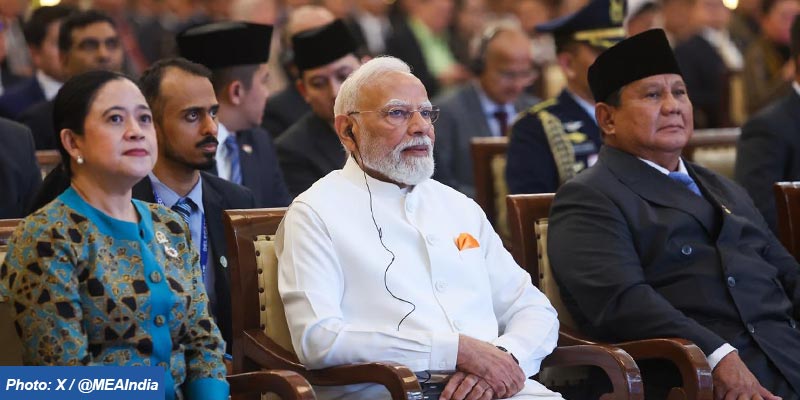
• Prime Minister Narendra Modi addressed the Parliament of Indonesia in Jakarta on July 7.
• He is the first Indian Prime Minister to address the Indonesian Parliament.
• Highlighting India’s development journey and the synergies between the vision of Viksit Bharat 2047 and Golden Indonesia 2045 (Indonesia Emas 2045), PM Modi called for deeper collaboration in trade, investment, connectivity, food and energy security, digital public infrastructure, and emerging technologies.
• PM Modi recalled the historic rescue of Indonesian leaders by former Odisha Chief Minister Biju Patnaik.
• Following Indonesia’s declaration of independence from Dutch rule on August 17, 1945, the Dutch placed Prime Minister Sutan Sjahrir and Vice President Mohammad Hatta under house arrest in Jakarta.
• In July 1947, Jawaharlal Nehru, yet to officially take charge as India’s first PM, ordered a covert operation to rescue the two leaders, tasking Biju Patnaik, who was an ace pilot, with their extraction.
• Patnaik and his co-pilot wife, Gyanwati Patnaik, flew a Dakota aircraft to Indonesia and safely extracted both leaders, bringing them to New Delhi via Singapore despite Dutch threats to shoot down the aircraft.
• In his speech, PM Modi referred to India’s Republic Day celebrations in 1950, when then Indonesian President Sukarno was the chief guest.
• He also mentioned the Bandung Conference hosted by Indonesia in 1955.
• The 1955 Bandung Conference brought together leaders from 29 Asian and African countries to promote world peace and advance cooperation among newly independent nations. It is widely regarded as laying the foundation for the Non-Aligned Movement during the Cold War.
• Nehru, who was then India’s Prime Minister, was one of its organisers.
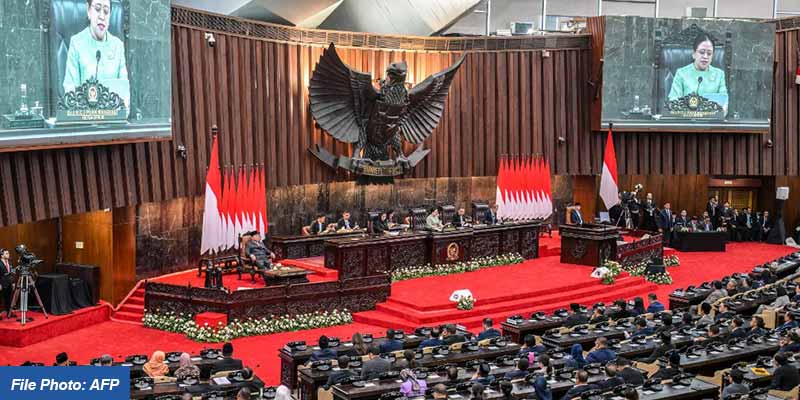
Key facts about Indonesian Parliament:
• Indonesia has a presidential system similar to that of the United States, in that the President is head of both State and government.
• The President appoints government ministers, approves legislation adopted by the parliament and is the supreme commander of the armed forces.
• Indonesia held its first direct presidential election in 2004. The President and the Vice President are elected as a pair by the people, for a maximum of two consecutive five-year terms.
• The President decides on the composition of the government.
• Indonesia’s two chambers of parliament are known as the People’s Consultative Assembly (Majelis Permusyawaratan Rakyat).
• The lower and more important chamber is the House of Representatives (Dewan Perwakilan Rakyat, DPR).
• The Council of Representatives of the Regions (Dewan Perwakilan Daerah, DPD), created in 2004, does not have the power to review legislation passed by the DPR.
• The House of Representatives (DPR) adopts legislation and the budget, and ratifies international agreements.
• In 2019, it was enlarged from 560 to 575 seats. Since the 2024 elections, the DPR has 580 members.
• Members are elected by proportional representation on a party-list system from 80 constituencies, with the number of seats per constituency ranging from three to 10.
• The Council of Representatives of the Regions (DPD) debates regional matters, and can also present Bills on regional matters to the DPR, but does not adopt legislation itself.
• It is elected directly by the Indonesian people, at the same time as the DPR. Voters elect four members on a non-partisan basis for each of Indonesia's 38 provinces, giving a total of 152 seats.
• The Parliament can impeach the President by a two-thirds majority of votes cast by both houses sitting together.
(The author is a trainer for Civil Services aspirants.)