
- India
- Jul 10
- Sreesha V.M
PM Modi, Albanese participate in 3rd India-Australia Annual Summit
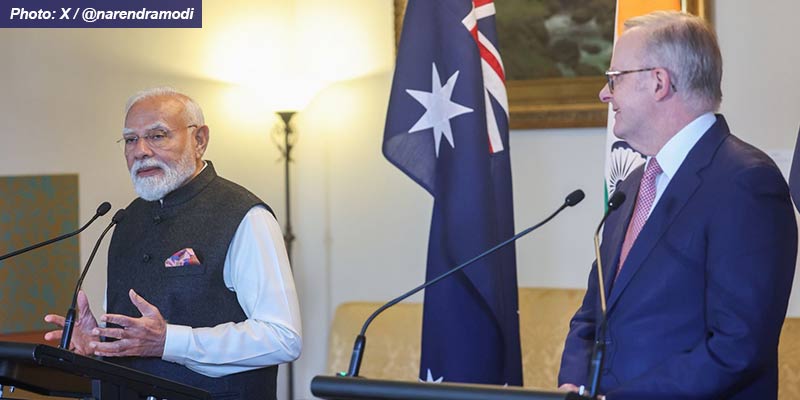
• Prime Minister Narendra Modi and his Australian counterpart Anthony Albanese participated in the 3rd India-Australia Annual Summit in Melbourne on July 9.
• The Prime Ministers welcomed the successful completion of six years of the India-Australia Comprehensive Strategic Partnership.
• They reviewed the significant progress achieved across the full spectrum of bilateral relations and discussed ways to further deepen cooperation in priority areas, including trade and investment, defence and security, critical minerals, cyber and emerging technologies, space, civil nuclear, clean energy, education, and people-to-people ties.
• They noted the expanding economic partnership and reaffirmed their commitment to early finalisation of an ambitious, balanced and mutually beneficial Comprehensive Economic Cooperation Agreement (CECA).
List of outcomes of the Summit:
1) Joint Declaration on Defence and Security Cooperation (JDDSC): Renews the existing Joint Declaration on Security (2009). It identifies interoperability of forces, capacity building, maritime domain, defense industrial collaboration, cyber security and technology, counter-terrorism, humanitarian assistance and disaster relief, and unified approach in UNCLOS, ASEAN, Pacific Islands Forum (PIF), Indian Ocean Rim Association (IORA), as areas of cooperation.
2) Maritime Security Collaboration Roadmap (MSCR): Enhances maritime security cooperation by promoting information sharing, capability development, and operational coordination.
3) India-Australia joint statement on energy security: Reaffirms the commitment of both countries to energy security in the face of geopolitical tensions.
4) Finalisation of administrative arrangement of India-Australia Civil Nuclear Agreement: Operationalises the India-Australia Civil Nuclear Agreement signed in 2015, and enables supply of uranium from Australia to India.
5) Australia-India Partnership for Cyber, Critical Technologies, Supply Chains (PACTS): Builds on the 2020 Framework Arrangement on Cyber and Cyber Enabled Critical Technology Cooperation. Aims to support national and regional security, promote collaboration to make critical supply chains more resilient, and strengthen collaboration in critical technologies, cyber security, and digital resilience.
6) India-Australia sports collaboration roadmap: Aimed at promoting establishment and operationalisation of high-performance sports centres in India. It will promote experience sharing for major sporting events such as Olympics and Commonwealth Games and identifies para sports as a key priority.
7) MoU between Indian Coast Guard (ICG) and Maritime Border Command (MBC) of Australia: Establishes cooperation in the field of maritime law enforcement, domain awareness, and maritime border protection between ICG and MBC.
8) MoU between Ministry of Skill Development and Entrepreneurship (MSDE),and Technical and Further Education (TAFE), government of Western Australia to set up a Centre of Excellence in Mining and Mining Equipment, Technology and Services (METS).
9) Handing over Letter of Intent (LoI) to Flinders’ University for setting up its campus in Bengaluru.
10) Signing of Letter of Intent (LoI) between National Council for Vocational Education and Training (NCVET) and Australian Skills Quality Authority (ASQA): It will strengthen regulatory frameworks in vocational training systems, co-development and alignment of occupational standards in priority sectors, and enable capacity building of officials, staff exchanges, joint workshops/research activities.
11) MoU under Australia-Canada-India Technology and Innovation (ACITI) Partnership: Aims to advance trilateral cooperation in emerging technologies and innovation, under the Australia-Canada-India Technology and Innovation (ACITI) Partnership.
12) MoU between GeoScience Australia (GA) and Geological Survey of India (GSI): Builds on the MoU on scientific and technical cooperation signed in 2015. Aimed at adoption of advanced exploration methodologies, capacity building and skill development, and enable technological upgradation and modernisation of GSI infrastructure.
13) MoU between Council of Scientific and Industrial Research (CSIR) and University of Melbourne: Establishes linkages between both institutions for future collaboration including collaborative research programs towards drug target identification, trainee programs, and faculty exchange programs.
14) Handing over of Letter of Approval to Victoria University: Permits the Victoria University to set up and operate its campus in Gurugram.
(The author is a trainer for Civil Services aspirants.)