
- India
- Jul 10
- Sreesha V.M
India, Australia announce PACTS partnership in cyber, critical technologies
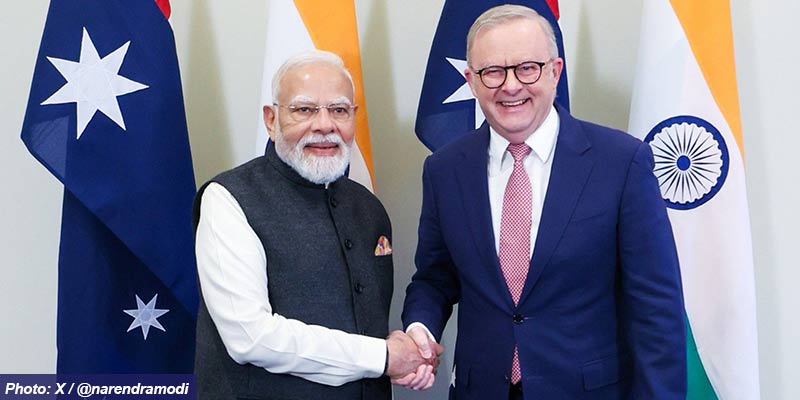
• Prime Minister Narendra Modi and his Australian counterpart Anthony Albanese agreed on an Australia-India Partnership on Cyber, Critical Technologies and Supply Chains (PACTS) during their delegation-level talks in Melbourne on July 9.
What is the significance of PACTS?
• India and Australia have built an enduring partnership in cyber and critical technologies underpinned by the Comprehensive Strategic Partnership, the 2020 Framework Arrangement on Cyber and Cyber Enabled Critical Technology Cooperation (2020 Framework), and two decades of collaborative research, operational coordination and policy engagement.
• Recognising that supply chains, critical technology and cyber security drive economic growth, are central to national security and can be used to shape values and global norms, India and Australia will build on pre-existing foundations and elevate bilateral ambition under PACTS, succeeding and replacing the 2020 Framework.
• The PACTS aims to support shared interest in national and regional security, empower partners with greater digital choices, make critical supply chains more resilient, and strengthen global cyber resilience.
• Safety, security, resilience, inclusivity for all, and shared democratic values will be built into every stage of the efforts under the partnership, demonstrating our countries’ commitment in being responsible technology leaders.
• The partnership will be chaired at a senior level by the Australian Deputy Secretary International and Security Group, Department of the Prime Minister and Cabinet and the Indian Deputy National Security Adviser.
Pillars for Cooperation
• Streamlining these efforts under an overall unifying strategic vision will allow to pursue targeted activities under five pillars of cooperation.
• Under each interrelated pillar, India and Australia will identify opportunities and specific projects to support collaboration between the private sector, universities, research institutions and government agencies.
Pillar 1: Supply Chain Resilience and Diversification
India and Australia will work towards secure, resilient and trustworthy supply chains to support growing technical industries, including by promoting security and safety by design and protective regulatory frameworks and deepening rules-based bilateral technology trade and supply chains. It will develop collaboration between Australian and Indian research institutes focused on protecting semi-conductor supply chains, and facilitating co-development and research to bolster their efforts.
Pillar 2: Critical Technology
India and Australia will work together to strengthen the security, resilience and integrity of priority critical technologies and innovate on new technologies in critical areas such as artificial intelligence (AI), space technologies, telecommunications, biotechnology and advanced materials. Both sides will seek to protect essential digital and physical infrastructure, accelerate innovation and research, and shape interoperable, consensus-driven international standards, to support long-term economic security and regional stability in the Indo-Pacific.
Pillar 3: Cybersecurity
India and Australia will work together to bolster the safety and security of the cyber and digital domain. This includes countering cybercrime, deterring malicious cyber activity, exchanging knowledge and experiences related to cyber and technology security norms, and protecting critical national infrastructure.
Pillar 4: Digital Resilience
Both countries will seek to deliver trusted and scalable technology solutions to support digitalising economies across the Indo-Pacific. Will support new partnership exchanges with countries in the Indo-Pacific on India’s Digital Public Infrastructure (DPI) principles.
Pillar 5: Defence Research Collaboration
India and Australia will work together to leverage defence research partnerships to advance a shared understanding of multi-domain defence challenges and capabilities. Both sides will build on past joint research, design future projects in accordance with our shared interests and increase exchanges between our defence science organisations under the Implementing Arrangement concerning cooperation in Defence Science and Technology to the Memorandum of Understanding on Defence Cooperation.