
- India
- Jul 11
- Sreesha V.M
India, New Zealand elevate ties to ‘Strategic Partnership’
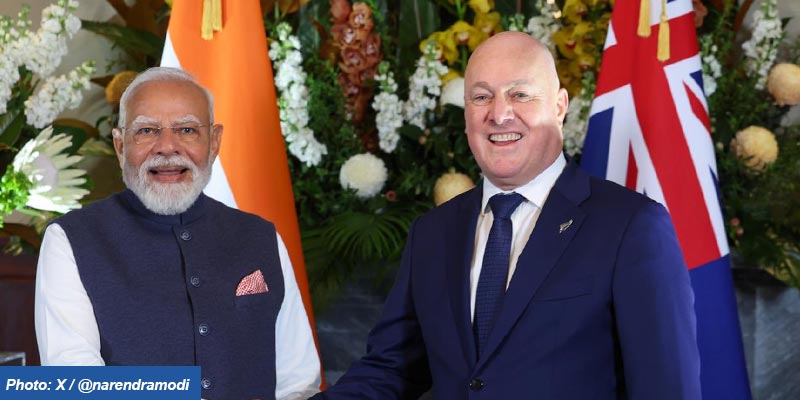
• Prime Minister Narendra Modi met his New Zealand counterpart Christopher Luxon in Auckland on July 10.
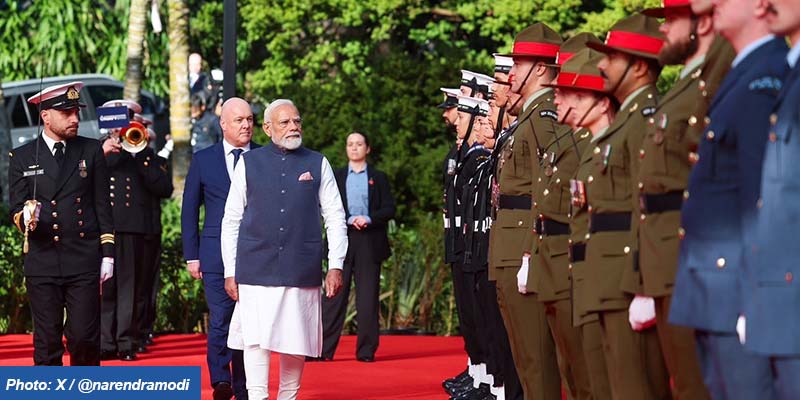
• PM Modi was accorded a traditional Maori welcome. The ceremony included customary Maori rituals symbolising peace, respect and welcome.
• The visit is the first by an Indian Prime Minister to New Zealand in 40 years.
• The two Prime Ministers held discussions and it covered the entire spectrum of bilateral relations, including trade and investment, defence and security, agri-tech, sports, education, tourism, culture and people-to-people ties.
• They agreed to elevate the bilateral relationship to the level of ‘Strategic Partnership’, marking a new chapter in India-New Zealand relations.
• Both sides have set a target to double bilateral trade to Rs 35,000 crore by 2030 to boost economic ties and expand market access, in the context of the Free Trade Agreement.
• They endorsed the ‘India-New Zealand Strategic Partnership: Roadmap to 2030’ as a framework to guide joint action over the next four years.
Other key outcomes of the meeting:
1) Maritime cooperation: Establishes a framework for enhanced maritime cooperation in the Indo-Pacific through dialogue, coordination, information exchange, and joint activities.
2) Cooperation in matters of hydrography and nautical cartography: Strengthens hydrographic cooperation through joint production of navigational charts, hydrographic data sharing, training, and capacity building.
3) Mutual logistics support: Facilitates reciprocal logistics support between the Indian Navy and the New Zealand Defence Force during approved activities and operations.
4) Joint working group on counter-terrorism: Establishes a joint working group on counter-terrorism to strengthen cooperation, exchange information, and coordinate efforts to combat terrorism.
5) Cooperation in disaster management: Promotes collaboration in disaster risk management, with emphasis on earthquake resilience, tsunami preparedness, coastal hazard mitigation, knowledge exchange, policy dialogue, and capacity building.
6) Memorandum of Arrangement in tourism: Promotes cooperation in tourism to strengthen economic ties, increase tourist flow, and enhance mutual understanding of each country’s culture.
7) Joint Action Plan on Sport: Provides a framework for collaboration in sports, including high-performance sport, sports science, sports medicine and athlete development
8) Maritime security as priority pillar under IPOI: Under the seven pillars of the Indo-Pacific Oceans Initiative (IPOI), New Zealand has joined the maritime security pillar to undertake specific cooperation activities focused on combating Illegal, Unreported and Unregulated (IUU) Fishing.
9) New Zealand joins Global Biofuels Alliance: New Zealand’s joining of the Global Biofuels Alliance strengthens international cooperation to accelerate the development and adoption of sustainable biofuels for cleaner energy transition.
10) Launch of the Kiwifruit Action Plan: Under the Agricultural Productivity Partnership, a Kiwifruit Action Plan is launched along with the establishment of two Centres of Excellence in Nagaland and Uttarakhand, supported by collaboration in education, skills development, and agricultural innovation to boost productivity.
11) MoU between the National Centre for Polar and Ocean Research (NCPOR), Goa and University of Canterbury: Establishes a framework for collaboration in Antarctic research. It aims to strengthen partnership by promoting joint research, academic exchange, capacity building, and other mutually beneficial scientific and educational activities.
(The author is a trainer for Civil Services aspirants.)