
- India
- Jul 14
India launches campaign for non-permanent seat at UNSC
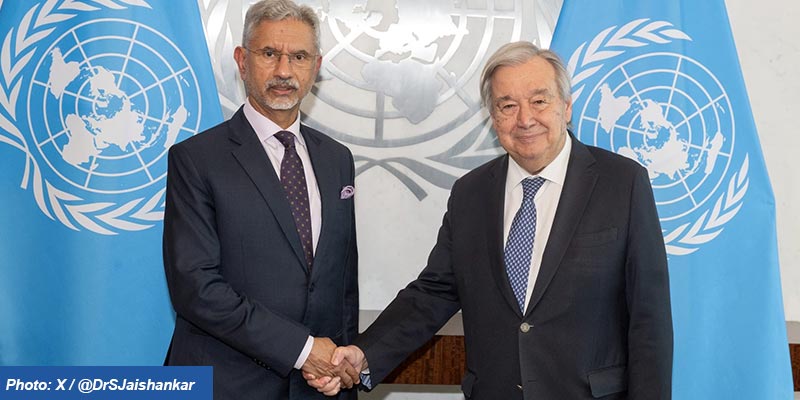
• Minister of External Affairs S. Jaishankar launched India’s official campaign for a non-permanent seat at the UNSC for the 2028-29 term at an event in the UN headquarters.
• Jaishankar outlined in detail India’s approach to the United Nations, emphasising that it is rooted in ‘SHANTI: Securing Holistic Advancement through Norms, Trust, Integrity’ as he launched India's campaign for the two-year tenure.
• The Security Council is composed of 15 countries, five of which — China, France, Russia, the United Kingdom and the United States — are permanent members.
• Ten non-permanent members are elected for two-year terms by the General Assembly.
• Elections for the 2028-29 term will be held in June 2027, when India and Tajikistan will compete for the sole seat in the Asia-Pacific Group.
• India last sat at the UNSC for the 2021-22 term, its eighth time in the UN Security Council after stints in 1950-1951, 1967-1968, 1972-1973, 1977-1978, 1984-1985, 1991-1992, 2011-2012.
UN Security Council
• The United Nations Charter established six main organs of the United Nations, including the Security Council. It gives primary responsibility for maintaining international peace and security to the Security Council.
• All members of the United Nations agree to accept and carry out the decisions of the Security Council. While other organs of the United Nations make recommendations to Member States, only the Security Council has the power to make decisions that Member States are then obligated to implement under the Charter.
• The Security Council held its first session on January 17, 1946 at Church House, Westminster, London. Since its first meeting, the Security Council has taken permanent residence at the United Nations Headquarters in New York City.
• A representative of each of its members must be present at all times at UN Headquarters so that the Security Council can meet at any time as the need arises.
• The Security Council takes the lead in determining the existence of a threat to the peace or act of aggression.
• It calls upon the parties to a dispute to settle it by peaceful means and recommends methods of adjustment or terms of settlement.
• In some cases, the Security Council can resort to imposing sanctions or even authorise the use of force to maintain or restore international peace and security.
• The Security Council has a presidency, which rotates, and changes, every month.
• The Council is composed of 15 members.
• Five permanent members are: China, France, Russian Federation, the United Kingdom, and the United States.
• Ten non-permanent members are elected for two-year terms by the General Assembly.
The 10 non-permanent seats are distributed on a regional basis as follows:
i) Five for African and Asian States.
ii) One for Eastern European States.
iii) Two for the Latin American and Caribbean States.
iv) Two for Western European and other States.
• Every year, the General Assembly elects five non-permanent members for a two-year term.
• Voting is conducted by secret ballot and candidates must receive a two-thirds majority, or 128 votes, even if they run uncontested.