
- India
- Jul 17
How hydrogen-powered train works?
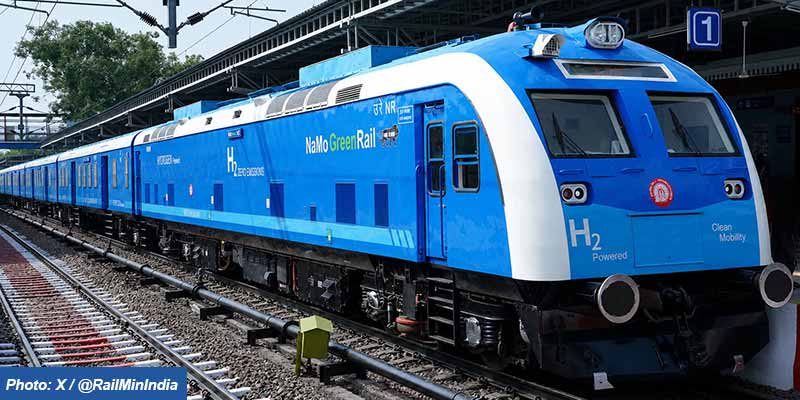
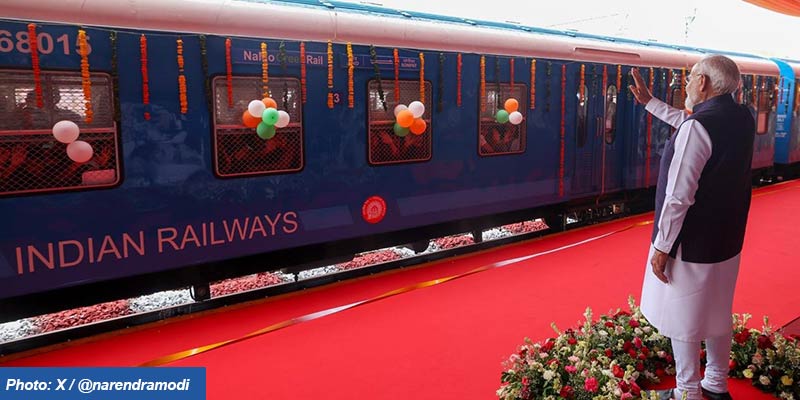
• Prime Minister Narendra Modi flagged off India’s first hydrogen-powered train connecting Jind to Sonipat in Haryana on July 17.
• With this, India joined a select group of countries exploring hydrogen-powered rail transportation. These include Germany, Japan, China and the United States.
• The route has been selected for demonstrating the operational viability, safety and reliability of hydrogen-powered passenger train services under regular operating conditions.
• As electricity is generated onboard through clean hydrogen technology, the train represents the greenest form of rail propulsion, powering the future of sustainable mobility.
Key features of the hydrogen-powered train:
• The train is powered by hydrogen fuel cell technology, which converts hydrogen into electricity to propel the train.
• A 1,200-kilowatt hydrogen-fuel-cell-propulsion system will power the 10-car trainset with a capacity of around 2,600 passengers.
• The train consists of two Hydrogen Driving Power Cars (DPCs) and eight trailer coaches.
• Each DPC houses fuel cells, lithium iron phosphate (LFP) batteries and hydrogen storage cylinders.
• Compared to diesel trains, they eliminate tailpipe emissions, lower dependence on fossil fuels, and operate with significantly less noise.
• Unlike conventional electric trains, they do not require continuous overhead electrification infrastructure, as electricity is generated onboard through hydrogen fuel cells, making them a clean and efficient solution.
• The train has an operational speed of 75 kmph on the Jind-Sonipat section and a design speed of 110 kmph.
Proton Exchange Membrane Fuel Cell (PEMFC)
• Hydrogen fuel cell technology produces electricity through a chemical reaction using hydrogen.
• The primary energy source is a Proton Exchange Membrane Fuel Cell (PEMFC).
• This is a fuel cell that generates electricity by reacting hydrogen and oxygen across a proton-conducting Perfluorosulfonic Acid (PFSA) polymer membrane.
• Hydrogen stored in the train’s cylinders combines with oxygen from the surrounding air inside the fuel cell, producing electricity that powers the traction motors and turns the wheels.
• The process produces only water vapour and heat as byproducts.
• There is no combustion, no smoke and no tailpipe carbon emissions.
• Hydrogen is a high-energy fuel, 120 MJ/Kg (megajoules per kilogram) in comparison to diesel, which is 43 MJ/Kg.
• It is low maintenance with a manageable carbon footprint.
Hydrogen storage facility
• The country’s largest railway hydrogen storage and refuelling facility has been established at Jind in Haryana.
• The indigenous facility stores nearly 3,000 kg of hydrogen at a time.
• It will support hydrogen-powered train operations.
• The Petroleum and Explosives Safety Organisation (PESO) has granted the required licence.
• Hydrogen is colourless and odourless. It is non-toxic.
• However, it is highly inflammable and needs to be handled with real care.
• Because hydrogen cannot be seen or smelled, the entire safety design of this project is built around one goal, which is to detect even the smallest leak instantly and never let it turn into a danger.
• The hydrogen ecosystem has been designed in accordance with internationally accepted standards.