
- India
- Jul 22
- Sreesha V.M
Govt launches ‘Mission Golden Spice’ for Meghalaya’s Lakadong turmeric
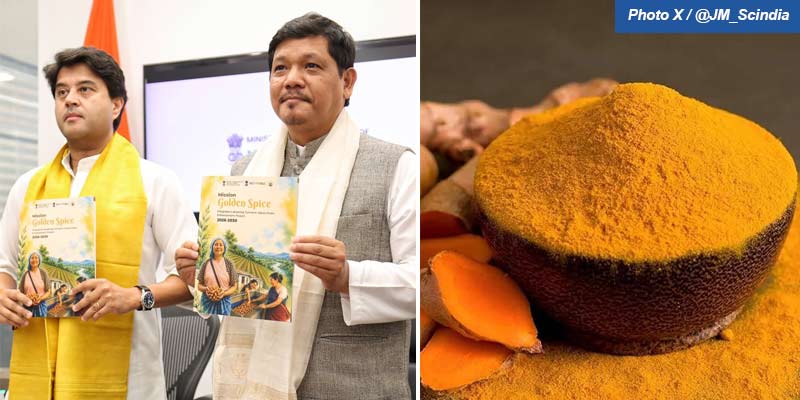
• The Union Minister for Development of North Eastern Region (MDoNER) Jyotiraditya M. Scindia and Meghalaya Chief Minister Conrad K. Sangma launched ‘Mission Golden Spice’ to transform GI-certified Lakadong turmeric into a globally competitive brand.
Key points on Lakadong turmeric:
• Turmeric is also known as ‘Golden Spice’.
• India is the largest producer, consumer and exporter of turmeric in the world.
• India produces over 70 per cent of the world’s turmeric.
• More than 30 varieties of turmeric are grown in India and it is grown in over 20 states in the country.
• The largest producing states of turmeric are Maharashtra, Telangana, Karnataka and Tamil Nadu.
• Turmeric is a flowering plant of the ginger family. It is a perennial, rhizomatous, herbaceous plant that reaches up to 1 metre in height. Highly branched, yellow to orange in colour that produces cylindrical and aromatic rhizomes, the leaves are alternate and arranged in rows.
• Turmeric (Curcuma longa) is used as spice, herbs, preservative, colouring matter (dye), cosmetics and has a wide range of medicinal and pharmacological applications.
• West Jaintia Hills district of Meghalaya is native to one of the finest varieties of turmeric in the world.
• The Lakadong variety is indigenous to Meghalaya and is famous for its high curcumin content of about 6.8-7.5 per cent, in comparison to 3 per cent or less in other varieties.
• It is slightly dark in colour compared to any other turmeric varieties found in India.
• The name of this turmeric variety is derived from the place where it originated.
• The GI tag will help farmers in marketing and give access to customers to the authentic product.
• Lakadong turmeric is a symbol of the state’s indigenous knowledge, culture and agricultural heritage.
Significance of the mission
• For years, farmers had sold the produce largely raw and semi-processed, limiting rural incomes.
• Mission Golden Spice is designed to change that by expanding cultivation, establishing the northeast's largest integrated organic turmeric processing and curcumin extraction facility, and placing women at the centre of the Mission's farmer institutions and enterprises.
• Anchored by MDoNER and the North Eastern Council (NEC), the Mission builds upon convergence with schemes and interventions of the ministries and various departments for establishing an integrated turmeric value-chain ecosystem in Meghalaya.
• The Mission is designed as a phased, five-year roadmap (2025-2030), to be implemented in two phases:
Phase 1: Value Chain Strengthening.
Phase 2: Expansion & Scale-up.
• The Mission aims to benefit more than 17,500 farmers across West and East Jaintia Hills by strengthening the entire value chain — from cultivation and certification to processing, branding, value addition and exports.
• The programme also envisages expanding the area under Lakadong turmeric cultivation from 2,500 hectares to 7,000 hectares and promoting exports to markets such as the US, the European Union, Japan and the Gulf countries.
• The Mission targets annual production of 49,400 metric tonnes of Lakadong turmeric by 2030, with women expected to account for 99 per cent of participation in processing and institutional activities.
(The author is a trainer for Civil Services aspirants.)