
- India
- Jul 28
What are Blue Straggler Stars?
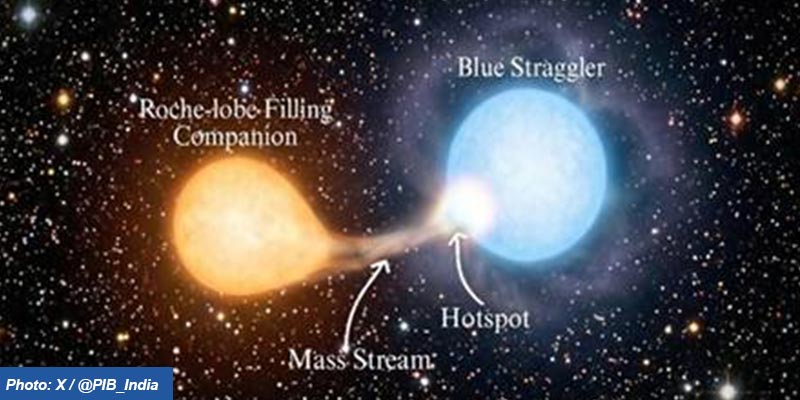
• Blue Straggler Stars (BSS) are a peculiar class of stars found in star clusters that appear hotter, brighter, and more massive than their peers, and have long puzzled astronomers seeking to understand their origin and evolution.
• Their very existence contradicts standard theories of stellar ageing, prompting decades of debate over whether they are created through violent stellar collisions or through more subtle interactions between pairs of stars.
• They shine bluer and brighter than their neighbours, looking far younger than their true age.
• The most widely accepted explanation is that these stars gain mass from a companion or through stellar mergers, effectively rejuvenating themselves.
• Yet, direct observational evidence of such formation processes has remained extremely rare.
• Indian astronomers, along with their international collaborators, have reported the rare discovery of a Blue Straggler Star caught in the act of formation, providing direct evidence of how such stars are created.
How was the study conducted?
• Astronomers from Indian Institute of Astrophysics (IIA), an autonomous institute of the Department of Science and Technology (DST), studied a remarkable binary star system TIC 327546480 in the old open star cluster Collinder 261, located about 9,500 light-years away.
• The system was identified as a promising candidate for further investigation since its properties suggested ongoing interaction between the two stars.
• The study combined high-precision light curves from NASA’s TESS space mission with radial velocity measurements obtained using the Very Large Telescope operated by the European Southern Observatory in Chile.
• They found the binary system to be semidetached, meaning that one of the two stars has expanded enough to overflow its gravitational boundary, known as the ‘Roche lobe’, causing the less massive companion star to transfer matter to the BSS.
• This ongoing mass transfer from the less massive companion to the BSS confirms that the rejuvenation process is still taking place, making the system one of the clearest examples of a forming Blue Straggler Star identified so far.
• The researchers also detected strong X-ray emission from the system. Such X-ray activity is expected when material transferred from the companion is being accreted by the BSS, providing independent evidence that mass transfer is currently ongoing.
• The results of this work have been published in the Astrophysical Journal Letters.