
- India
- Jul 28
- Sreesha V.M
Centre aims to complete Kosi-Mechi link project in Bihar by March 2029
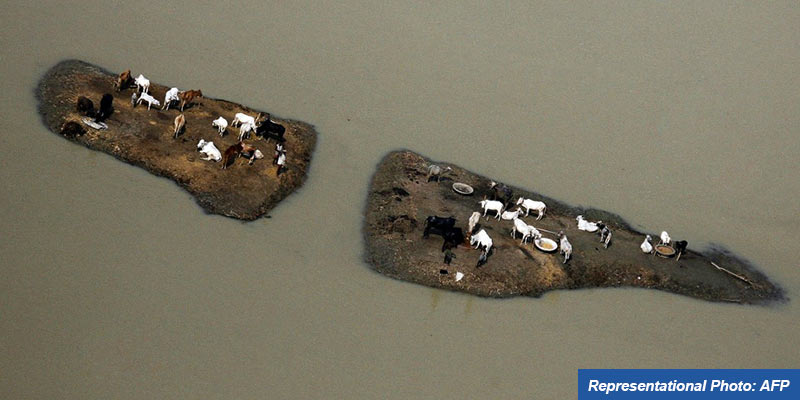
• The Kosi-Mechi intra-state link project in Bihar is scheduled for completion by March 2029, Minister of State for Jal Shakti Raj Bhushan Choudhary said in a written reply in the Rajya Sabha on July 27.
• The Centre has included the project under the Pradhan Mantri Krishi Sinchayi Yojana's Accelerated Irrigation Benefit Programme (PMKSY-AIBP) for balance cost of works of Rs 6,143.22 crore, with central assistance of Rs 3,652.56 crore.
• The Kosi-Mechi project is the tenth to be included in the AIBP component of PMKSY since 2021.
Key points on Kosi river:
• The Kosi River is a transboundary river spanning over three countries — Tibet, Nepal, and India.
• The river Kosi originates in the Himalayas.
• The upper catchment of the river system lies in Nepal and Tibet.
• Mount Everest and Kanchenjunga are in the Kosi catchment.
• It is known as Sapta Kosi in Nepal.
• It enters Indian territory near Hanuman Nagar in Nepal.
• It joins the Ganga river near Kursela in Katihar district.
Kosi-Mechi intra-state link project
• Kosi-Mechi intra-state link project envisages diversion of part of surplus water of Kosi river for extending irrigation to Mahananda basin lying in Bihar by way of remodelling of existing Eastern Kosi Main Canal (EKMC) and extending the EKMC beyond its tail end at RD 41.30 km up to river Mechi at RD 117.50 km so that rivers Kosi and Mechi which flow through Bihar could be linked together within Bihar.
• The project will provide 2,10,516 hectares additional annual irrigation in Kharif season in Araria, Purnea, Kishanganj and Katihar districts of Bihar.
• The project has potential to divert/utilise about 2,050 million cubic meter of surplus water of Kosi through the proposed link canal.
• Further, after remodelling of existing Eastern Kosi Main Canal, shortfall supply to 1.57 lakh hectare existing command of existing Eastern Kosi Main Canal shall be restored.
• The remodelling of the Eastern Kosi Main Canal from km 0 to 41.30 has been taken up at an awarded contract value of Rs 2,639.80 crore.
• Physical progress of 8.5 per cent has been achieved so far.
Pradhan Mantri Krishi Sinchai Yojana (PMKSY)
• Launched on July 1, 2015, the Pradhan Mantri Krishi Sinchayee Yojana (PMKSY) is being implemented to expand cultivated areas with assured irrigation, reduce wastage of water and improve water use efficiency.
• PMKSY is an umbrella scheme, providing central grants to the state governments for specific activities.
• The government approved implementation of PMKSY during 2021-26 with an overall outlay of Rs 93,068.56 crore (central assistance of Rs 37,454 crore).
• PMKSY consists of two major components by the department of water resources, river development and ganga rejuvenation.
They are:
1) Accelerated Irrigation Benefits Programme (AIBP)
2) Har Khet Ko Pani (HKKP).
• In addition, Watershed Development part is being implemented by the department of land resources.
• Another component of PMKSY, ‘Per Drop More Crop’ is being implemented by the department of agriculture and farmers welfare.
1) Accelerated Irrigation Benefit Programme
• It is a flagship programme of the government that aims for financial support to irrigation projects.
• Total additional irrigation potential creation targeted during 2021-26 under AIBP is 13.88 lakh hectare.
• The inclusion criteria have been relaxed for projects under tribal and drought prone areas.
• Since April 2016, as many as 63 projects have been completed under PMKSY-AIBP, creating additional irrigation potential for 26.11 lakh hectares.
2) Har Khet Ko Pani (HKKP)
HKKP consists of four sub-components. They are:
i) Command Area Development (CAD)
ii) Surface Minor Irrigation (SMI)
iii) Repair, Renovation and Restoration of Water Bodies
iv) Ground Water Development.
• It aims for enhancement of physical access on the farm and expansion of cultivable area under assured irrigation.
• Under HKKP, Surface Minor Irrigation (SMI) and Repair, Renovation and Restoration of Water Bodies sub-components are targeted to provide additional 4.5 lakh hectare irrigation.
• In view of the importance of rejuvenation of water bodies, the Cabinet has approved a paradigm shift in funding of their rejuvenation in both urban and rural areas, with significant expansion of their inclusion criteria, and enhancement of central assistance from 25-60 per cent in general area.
• Further, the Ground Water Development component of HKKP, approved provisionally for 2021-22, targets creation of irrigation potential of 1.52 lakh hectare.
(The author is a trainer for Civil Services aspirants.)