
- India
- Jul 29
Maldives President calls for SAARC revival
• Maldives is prepared to facilitate the resumption of the meetings of the SAARC, President Mohamed Muizzu said.
• Speaking at the Maldives’ 61st Independence Day ceremony, Muizzu described SAARC as an important regional organisation.
• Reviving SAARC and restarting meetings among its member states are essential for maintaining peace and stability in the region, he added.
• Responding to the statement of Maldives’ President, India sought to hold Pakistan responsible for “stymieing” cooperation under the framework of the SAARC.
• In the last few years, India has made concerted efforts to make BIMSTEC (Bay of Bengal Initiative for Multi-sectoral Technical and Economic Cooperation) a vibrant forum for regional cooperation as initiatives under SAARC were not moving forward.
What is SAARC?
• The South Asian Association for Regional Cooperation (SAARC) was established on December 8, 1985.
• SAARC is an economic and political regional organisation of countries in South Asia.
• The Secretariat of the Association was set up in Kathmandu, Nepal, in January 1987.
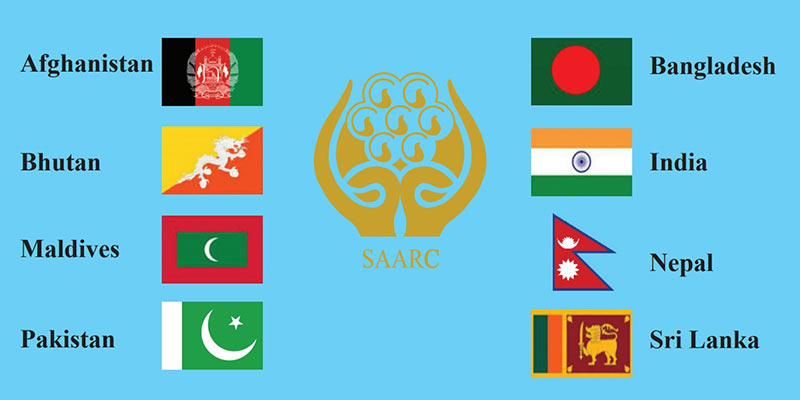
• SAARC has eight member countries — Afghanistan, Bangladesh, Bhutan, India, Maldives, Nepal, Pakistan and Sri Lanka.
• SAARC aims to accelerate the process of economic and social development in its member states through increased intra-regional cooperation.
• As per the Ministry of External Affairs (MEA), SAARC region is home to nearly 1.9 billion people, representing approximately 24 per cent of the world's population, with a combined GDP of around $5 trillion.
The objectives of SAARC are:
i) To promote the welfare of the peoples of South Asia and to improve their quality of life.
ii) To accelerate economic growth, social progress and cultural development in the region and to provide all individuals the opportunity to live in dignity and to realise their full potential.
iii) To promote and strengthen collective self-reliance among the countries of South Asia.
iv) To contribute to mutual trust and understanding of one another’s problems.
v) To promote active collaboration and mutual assistance in the economic, social, cultural, technical and scientific fields.
vi) To strengthen cooperation with other developing countries.
vii) To strengthen cooperation among themselves in international forums on matters of common interests.
viii) To cooperate with international and regional organisations with similar aims and purposes.
• The SAARC has not been very effective since 2016 as its biennial summits have not taken place since the last one in Kathmandu in 2014.
• The 2016 SAARC Summit was to be held in Islamabad. But after the terrorist attack on an Indian Army camp in Uri in Jammu & Kashmir on September 18 that year, India expressed its inability to participate in the summit.
India and SAARC
• India is a founding member of the SAARC.
• India continues to support various initiatives in the SAARC framework to achieve closer cooperation in diverse areas.
• Out of the 18 SAARC Summits held so far, India has hosted three — in 1986, 1995 and 2007.
• As per the ‘Neighbourhood First’ policy, India is an active development partner and is engaged in several projects in neighbouring countries.
• The engagement with these countries is based on a consultative, non-reciprocal and outcome-oriented approach, while focussing on delivering benefits like greater connectivity, improved infrastructure, stronger development cooperation in various sectors area, security and broader people-to-people contacts.
• India’s initiative of extending its National Knowledge Network (NKN) to the countries of South Asia has been extended to Sri Lanka, Bangladesh and Bhutan.
• India is home to South Asian University (SAU). It was established through an Inter-Governmental Agreement at the 14th SAARC Summit (April 2008) to provide world class educational facilities and professional faculty to students and researchers from SAARC countries.