
- India
- Jul 29
President Murmu completes 4 years in office
• President Droupadi Murmu completed three years in office on July 25.
• Murmu was sworn in as the 15th President on July 25, 2022, making her the country’s first tribal Head of State.
• To mark this occasion, the President graced the inauguration and laying of foundation stones for various initiatives undertaken in Rashtrapati Bhavan and the President’s Estates.
These initiatives are:
• The first set of five commemorative books marking four years of her presidency were released.
These books are:
i) Rashtrapati Bhavan: Rashtra Ka Bhavan (President Droupadi Murmu’s first year of Presidency).
ii) Seva Aur Samvedana (President Droupadi Murmu’s second year of Presidency).
iii) Samaveshi Sahbhaghita (President Droupadi Murmu’s third year of Presidency).
iv) Bharatiyata Ka Utsav (President Droupadi Murmu’s fourth year of Presidency).
v) An Odia book, Ama Rastrapati Ama Gourav, a collection of articles on the President.
• The President launched the third edition of e-Upahaar, featuring 300 curated presidential gifts for public auction. The auction will be open from August 5 to September 5 at upahaar.rashtrapatibhavan.gov.in
• Launch of an e-audio guide for visitors to Rashtrapati Bhavan to enhance their experience. The application-based e-audio guide will be available in Hindi, English and 14 other Indian languages, while its sign language module will also be available for visitors.
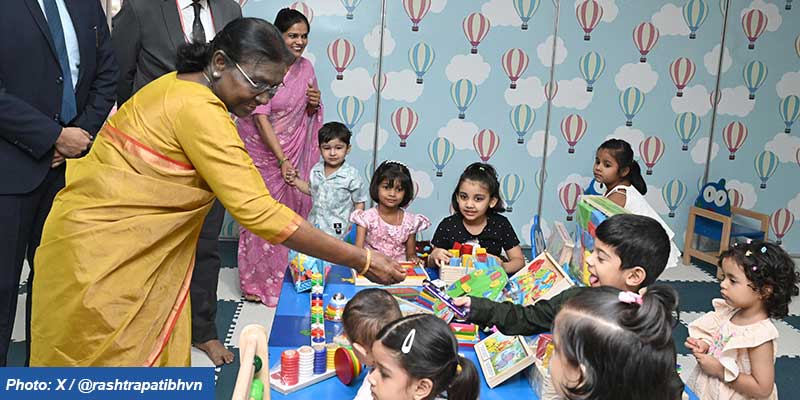
• Inauguration of ‘Bachpan Bal Parisar’ for the children in the President’s Estate. The initiative includes ‘Kilkari’, a play zone for children, and ‘Samarth Anganwadi-cum-Palna’, which provides a safe and nurturing environment for their growth and development.
• Launch of RAAHI (Rashtrapati Bhavan Access And Heritage Interconnector), a fare-free electric bus service to promote green and inclusive mobility. This bus service for the staff and residents of the President’s Estate is being operated by women drivers and conductors.
• Laying of foundation stone for the construction of service block as part of Net Zero Energy Strategy.
• Inauguration of accommodation facilities at Rashtrapati Niketan, Dehradun and Rashtrapati Nilayam, Secunderabad as well as laying of foundation stone for the redevelopment of staff quarters in the President’s Estate.
Some important points on President of India:
• The President of India is the Head of the State and exercises powers as defined in the Constitution of India.
• The President is the nominal head of the executive, the first citizen of the country, as well as the Commander-in-Chief of the Indian Armed Forces.
• The President’s Secretariat provides secretarial assistance to the President in discharging constitutional, ceremonial and other State responsibilities.
• The President summons, prorogues, addresses, sends messages to Parliament and dissolves the Lok Sabha, promulgates Ordinances at any time, except when both Houses of Parliament are in session, makes recommendations for introducing financial and money Bills and gives assent to Bills, grants pardons, reprieves, respites or remission of punishment or suspends, and remits or commutes sentences in certain cases.
• The President can proclaim emergency in the country if he/she is satisfied that a grave emergency exists, whereby security of India or any part of its territory is threatened, whether by war or external aggression or armed rebellion.
• The President is elected by members of an electoral college consisting of elected members of both Houses of Parliament and Legislative Assemblies of the states in accordance with the system of proportional representation, by means of single transferable vote.
• The President must be a citizen of India, not less than 35 years of age, and qualified for election as member of the Lok Sabha.
Term of Office of President
The President shall hold office for a term of five years from the date on which he enters upon his office:
Provided that-
a) The President may, by writing under his hand addressed to the Vice-President, resign his office.
b) The President may, for violation of the Constitution, be removed from office by impeachment in the manner provided in Article 61.
c) The President shall, notwithstanding the expiration of his term, continue to hold office until his successor enters upon his office.