
- India
- Jul 30
25 years of Himalayan Chandra Telescope in Hanle
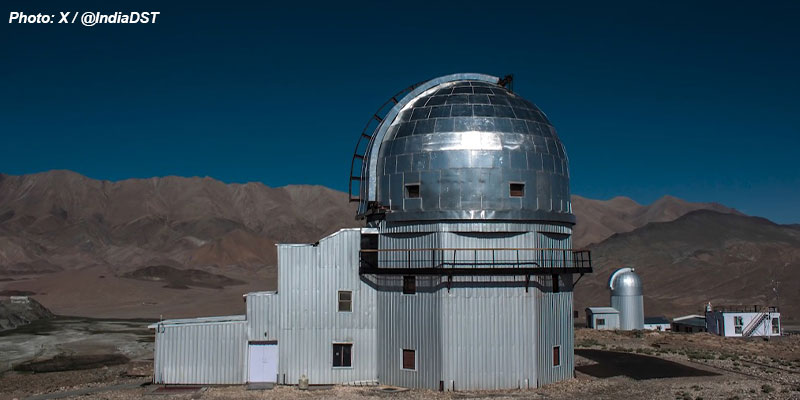
• The Department of Science and Technology (DST) celebrated 25 years of the successful operations of the 2-metre Himalayan Chandra Telescope (HCT) atop Hanle in Ladakh.
Key features of Himalayan Chandra Telescope:
• Establishing an optical telescope in the trans-Himalayan region had been the dream of the Indian astronomical community for many decades.
• Following suggestions made by a panel set up by the Planning Commission, the Indian Institute of Astrophysics (IIA), an autonomous institution of the DST, was identified in 1989 as the nodal agency to identify a suitable location for optical and infrared facilities.
• Teams of astronomers explored six different locations in the Himalayas, and zeroed in on Digpa Ratsa Ri, a mountain top in Hanle at 4,517 metres above sea level, in the cold high-altitude desert in Ladakh.
• With a large number of clear nights due to the Himalayas obstructing the monsoons, a very low atmospheric water vapour, and minimal light pollution from manmade sources, Hanle was selected as one of the ideal locations for optical and near-infrared astronomy in India.
• A telescope of 2-metre diameter was decided on, with a proposal to develop the site in the future to house much larger telescopes.
• The foundation stone for the Indian Astronomical Observatory was laid in 1997.
• It was named the ‘Himalayan Chandra Telescope’ (HCT), after the Nobel laureate Subrahmanyan Chandrasekhar.
• Currently, the HCT hosts HFOSC (a spectrograph and camera in the optical), uTIRSPEC (a near-infrared spectrometer and imager), and HESP (a high-resolution Echelle spectrograph).
• A unique feature of the telescope is that it has been operated remotely in real time from the Centre for Research and Education in Science and Technology (CREST), IIA in Hosakote near Bengaluru, since June 2001, through a dedicated INSAT-3B satellite link from ISRO.
• The site has more than 250 usable nights a year, and with a precipitable water vapour of less than 2.5 mm with highly transparent skies, is ideal for near-infrared observations as well.
• The telescope yielded its very first scientific result in 2001, with a paper studying the optical afterglow of a gamma ray burst.
• HCT is used by astronomers from across India, to study objects as varied as planets and asteroids, to stars and galaxies.
• The Union Budget mentioned the setting up of the 3.7-m Upgraded HCT and the 13.7-m National Large Optical-infrared Telescope at Hanle, to be led by IIA.
• Driven by the experience gained from HCT, these will help leapfrog Indian astronomy to the next level while taking advantage of the site of Hanle, which remains a globally competitive location for astronomy.