
- India
- Jul 31
- Sreesha V.M
PM Modi chairs Cabinet Committee on Security (CCS) meeting
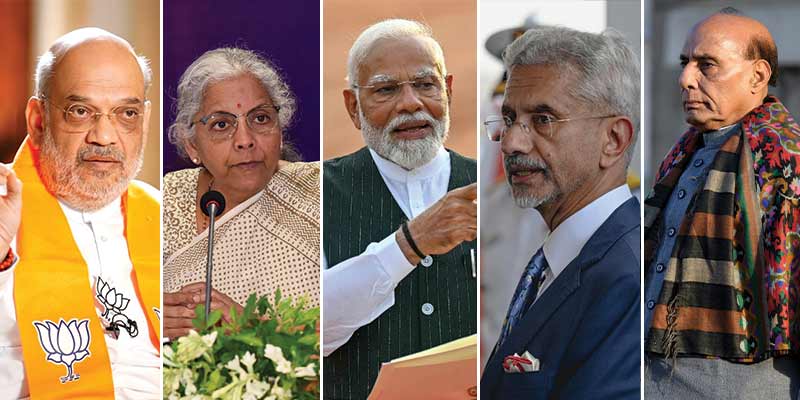
• Prime Minister Narendra Modi chaired a meeting of the Cabinet Committee on Security (CSS) on July 30 to review the situation in the context of ongoing West Asia conflict and measures taken by various ministries and departments.
• This was the fourth special CCS meeting on the issue.
What is a Cabinet Committee?
• Cabinet Committees are extra-constitutional, meaning, they are not mentioned in the Indian Constitution.
• Cabinet Committee is a group of ministers which can take collective decisions that are binding across various ministries/departments. They are partly designed to reduce the burden on the Union Cabinet by allowing smaller groups of ministers to take decisions on specific policy areas.
• The Cabinet Committees are constituted or reconstituted when a new government takes over or the Cabinet undergoes a reshuffle.
• The Prime Minister constitutes Standing Committees of the Cabinet and sets out the specific functions assigned to them.
• The Cabinet Secretariat is responsible for the administration of the Government of India (Transaction of Business) Rules, 1961 and the Government of India (Allocation of Business) Rules 1961, facilitating smooth transaction of business in ministries/departments of the government.
• This Secretariat provides secretarial assistance to the Cabinet and its Committees, and also assists in decision making in government by ensuring inter-ministerial coordination, ironing out differences amongst ministries/departments and evolving consensus through the instrumentality of the standing/ad hoc committees of secretaries. Through this mechanism new policy initiatives are also promoted.
Cabinet Committee on Security
The Cabinet Committee on Security is the country’s highest decision-making body on security affairs.
Functions of the Cabinet Committee on Security include:
i) Deal with all defence related issues.
ii) Deal with issues relating to law and order, and internal security.
iii) Deal with policy matters concerning foreign affairs that have internal or external security implications including cases relating to agreements with other countries on security related issues.
iv) Deal with economic and political issues impinging on national security.
v) Review the manpower requirements relating to national security including proposals concerning creation of posts carrying the pay scale or pay band plus grade pay equivalent to that of a joint secretary to the government of India and higher, and setting up new structures to deal with security related issues.
vi) Deal with all matters relating to atomic energy.
Members of the Cabinet Committee on Security:
i) Prime Minister Narendra Modi
ii) Defence Minister Rajnath Singh
iii) Home Minister Amit Shah
iv) Finance Minister Nirmala Sitharaman
v) Minister of External Affairs S. Jaishankar.
Escalating conflict in West Asia
• India depends on imports to meet over 88 per cent of its energy requirements.
• Before the US-Israel war with Iran, 40 per cent of India’s energy imports came through the Strait of Hormuz.
• With the conflict not ending, India’s energy imports from West Asia have been hit.
• Earlier in July, the Yemen-based Houthi militia announced that it will target Saudi Arabian tankers attempting to cross the Bab al-Mandab. The group also targeted a few ships following the announcement.
• The Bab al-Mandab connects the Red Sea to the Gulf of Aden and the Arabian Sea and is a critical transit point for global trade and energy supplies, similar to the Strait of Hormuz.
• The impact is already visible as ships crossing through the Bab al-Mandab decreased to an average 31 per day over the past three days in comparison to 43 per day in the first half of July.
• Besides, Russian oil import through the Black Sea is also under pressure as the Russia-Ukraine war has intensified.
• There have been several attacks on ships passing through the Black Sea in the past few days.
Key points discussed in the meeting:
• Sources for procurement of LPG have already been diversified and the overall stock and supply positions of major petroleum products remain adequate.
• Availability of adequate crude oil has enabled Central Public Sector Enterprise (CPSE) refineries to operate at utilisation levels exceeding 100 per cent, ensuring continued production of petrol, diesel and other petroleum products.
• Initiatives have also been taken to expand Piped Natural Gas (PNG) connections, which have resulted in a substantial increase in subscriptions.
• The government is also facilitating industrial substitution of LPG through expansion of the National Gas Grid, augmentation of LNG import and re-gasification infrastructure, expansion of City Gas Distribution networks, and time-bound pipeline and last-mile connectivity approvals under the Pipeline Infrastructure Order, 2026.
• Requirements for the fertilisers for the ensuing Rabi season was assessed and alternative sources of fertilisers were also discussed.
• The situation of seafarers serving on domestic as well as foreign-flagged vessels in conflict zones was also deliberated on.
(The author is a trainer for Civil Services aspirants.)