
- India
- Jul 31
- Sreesha V.M
Odisha, Chhattisgarh agree to resolve Mahanadi water dispute through dialogue
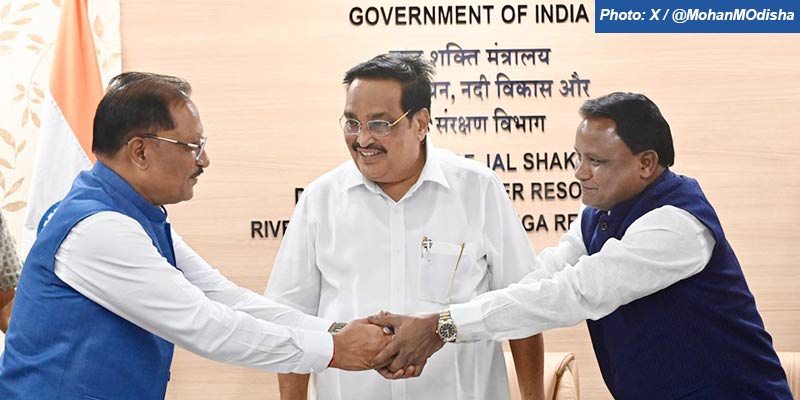
• Union Jal Shakti Minister C.R. Patil chaired a meeting with Chhattisgarh Chief Minister Vishnu Deo Sai and Odisha Chief Minister Mohan Charan Majhi to facilitate an amicable settlement of Mahanadi water dispute.
• It was decided at the meeting that a committee headed by the Chairman of the Central Water Commission will submit its report to the Mahanadi Tribunal within three months on resolution of the dispute.
History of Mahanadi water dispute
• Odisha alleged that the free flow of the river Mahanadi was blocked by construction of barrages and weirs in the upstream by Chhattisgarh to provide water to industries.
• Odisha pointed out that Chhattisgarh started many projects upstream of Hirakud Dam, which would have long term effect on the flow downstream especially during the lean period.
• The effect of projects upstream of Hirakud on long term flows downstream in Odisha will result in the retention of the major portion of the non-monsoon flow of water and will also affect ecologically sensitive coastal and delta area of Mahanadi.
• On the other hand, Chhattisgarh pleaded that 52.9 per cent of the total catchment of Mahanadi and 89.9 per cent of catchment up to Hirakud lies in their state and they had a right to use the water of Mahanadi.
• Chhattisgarh pointed out that Odisha also commenced certain major and medium projects without informing them as the upper riparian state.
• In November 2016, the Odisha government filed a complaint with the Ministry of Water Resources, River Development and Ganga Rejuvenation (now Ministry of Jal Shakti) under Section 3 of the Inter-State River Water Disputes (ISRWD) Act, 1956.
• The Odisha government requested the Union government to constitute a tribunal under Section 4(1) of the ISRWD Act for adjudication of water disputes in respect of river Mahanadi and its basin between the riparian states of Odisha and Chhattisgarh.
• The central government constituted a Negotiation Committee for settlement of the dispute.
• The Negotiation Committee submitted its report in May 2017, in which it mentioned that any further meetings of the committee would not be fruitful as there had been no participation from Odisha in the meetings.
• Accordingly, it was concluded that the dispute cannot be resolved by negotiation.
• Subsequently, the central government constituted Mahanadi Water Disputes Tribunal in March 2018.
• Over the past several years, extensive deliberations and efforts have been made at various levels regarding the sharing of the waters of the Mahanadi.
• The central government extended the tenure of the tribunal to ensure that all parties were provided adequate opportunity to present their views.
• Recently, the process has gained further momentum with both the states demonstrating their willingness to pursue an amicable settlement through mutual cooperation and technical consultations.
(The author is a trainer for Civil Services aspirants.)