
- India
- Aug 04
- Sreesha V.M
Glaw Lake becomes Arunachal Pradesh’s first Ramsar Site
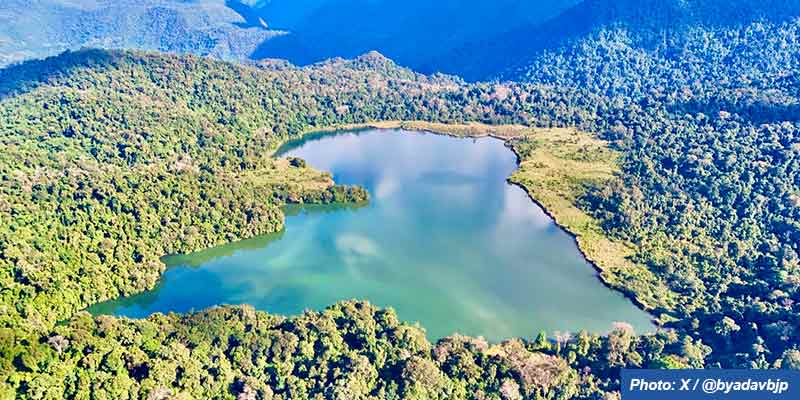
• The Glaw Lake in Lohit district became Arunachal Pradesh’s first Ramsar site of international importance.
• With this, India now has 101 Ramsar Sites.
Key points on Glaw Lake:
• The Site is a freshwater lake found within the Kamlang Tiger Reserve and Wildlife Sanctuary in the Eastern Himalayas, a biodiversity hotspot.
• It is fed by perennial mountain streams typical of the Himalayan foothill landscape and is surrounded by lush vegetation, with more than 150 tree species and 49 orchid species recorded within the Site and its catchment.
• The Site, together with the wider landscape of Kamlang Tiger Reserve and Wildlife Sanctuary, supports four species of big cats: tiger (Panthera tigris), leopard (Panthera pardus), clouded leopard (Neofelis nebulosa), and snow leopard (Panthera uncia).
• It also provides habitat and wintering ground to multiple water-dependent birds such as the critically endangered white-bellied heron (Ardea insignis) as well as over 20 reptiles and amphibians.
• Glaw Lake and its surroundings are a popular destination for hiking and nature-based recreation.
• The Lake is also an important cultural asset to the local Mishmi community, who regard it as sacred.
What is the Ramsar Convention?
• The Ramsar List is the world’s largest network of protected areas. There are over 2,500 Ramsar Sites, covering more than 2.5 million square kilometres.
• The Ramsar Convention is an international treaty signed by 172 countries to protect wetlands.
• It is named after the city in Iran where it was signed, and it began with 18 countries in 1971.
• The convention is one of the oldest inter-governmental accords for preserving the ecological character of wetlands. Also known as the Convention on Wetlands, it aims to develop a global network of wetlands for the conservation of biological diversity and for sustaining human life.
• It is one of the largest international agreements, after the Convention on Biological Diversity (CBD, 196 countries) and the UN climate agreement (UNFCCC, 197 countries).
• India ratified the convention on February 1, 1982.
• The first Site was the Cobourg Peninsula in Australia, designated in 1974. The largest Sites are Rio Negro in Brazil (120,000 sq km), and Ngiri-Tumba-Maindombe in the Democratic Republic of Congo and Queen Maud Gulf in Canada. These Sites each cover over 60,000 sq km.
• The countries with the most Sites are the United Kingdom with 176 and Mexico with 144. Brazil has the largest area with 267,000 square km under the Convention protection.
(The author is a trainer for Civil Services aspirants.)