
- India
- Aug 05
- Sreesha V.M
India launches conservation action plan for clouded leopard
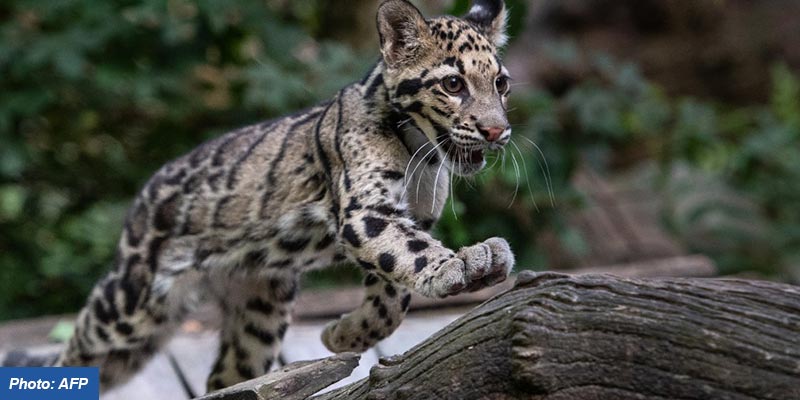
• The Ministry of Environment, Forest and Climate Change (MOEFCC) launched the Clouded Leopard Conservation Action Plan (CAP) on August 4.
Key facts about clouded leopard:
• The clouded leopard (Neofelis sp.) is a medium-sized felid found across Southeast Asia, with two currently recognised species: the mainland clouded leopard (Neofelis nebulosa) and the Sunda clouded leopard (Neofelis diardi).
• It is one of Asia’s most enigmatic and evolutionarily distinct wild cats.
• Clouded leopard is characterised by striking cloud-shaped markings, elongated canines, exceptional climbing abilities, and specialised arboreal adaptations.
• Adults typically weigh between 11 and 23 kg, with males being significantly larger than females.
• Although capable of both arboreal and terrestrial movement, it remains strongly associated with dense forest cover and occurs naturally at low densities.
• As a solitary carnivore, it preys on a variety of mammals, birds, and reptiles and plays an important ecological role in maintaining the structure and function of forest ecosystems.
• In India, the species is primarily restricted to the northeastern states and the eastern Himalayan region.
• The clouded leopard has experienced substantial population declines due to habitat loss, fragmentation, hunting, and illegal wildlife trade.
• The species is currently listed as Vulnerable on the IUCN Red List, with global populations estimated to have declined by more than 30 per cent over the past two decades.
• In India, the clouded leopard is listed under Schedule I of the Wild Life (Protection) Act (WPA), 1972, providing it absolute protection from hunting, trade and possession.
• The clouded leopard belongs to the sub-family Pantherinae, which includes the largest and most evolutionarily derived members of the Felidae family.
Highlights of the action plan:
• The Conservation Action Plan (CAP) marks an important step towards strengthening long-term conservation of the clouded leopard across Northeast India.
• The approach focuses on landscape-level conservation, scientific assessment, community participation and technology-driven interventions to protect the species and its habitats.
• A key component of the action plan is the identification of 14 priority conservation landscapes across Northeast India, along with landscape-scale habitat restoration and corridor conservation to strengthen connectivity between forest habitats.
• The government has also strengthened the institutional framework for clouded leopard conservation through the inclusion of the species under the Species Recovery Programme of the Integrated Development of Wildlife Habitats (IDWH) scheme.
• The action plan provides for standardised scientific monitoring through camera traps, occupancy surveys, genetics and environmental DNA (eDNA), enabling improved understanding of the species and its habitat requirements.
• It also emphasises strengthening anti-poaching measures and wildlife crime prevention.
Meghalaya launches Mission Clouded Leopard
• On International Clouded Leopard Day, Meghalaya Chief Minister Conrad K. Sangma launched Mission Clouded Leopard.
• It is a dedicated programme for the conservation of Meghalaya’s state animal.
• In Meghalaya, clouded leopard is found in the forest landscapes of Nokrek, Balpakram, Baghmara, Narpuh and Nongkhyllem, and in community-managed forests.
• The Mission covers habitat protection and restoration, scientific research and long-term monitoring, stronger protection measures, landscape connectivity, capacity building of frontline staff, community participation and public awareness.
• An ongoing scientific assessment has so far identified 21 individual clouded leopards in the Balpakram landscape.
(The author is a trainer for Civil Services aspirants.)