
- India
- Aug 13
- Sreesha V.M
India home to over 60% of world’s wild Asian elephants
• World Elephant Day is observed on August 12 every year.
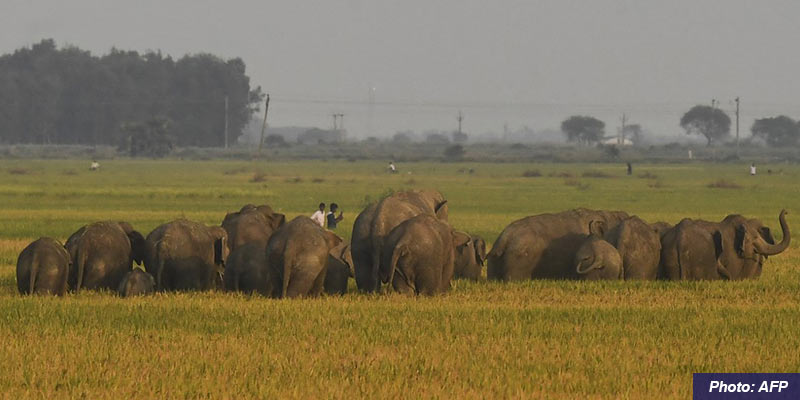
• India is home to nearly 60 per cent of the world’s wild Asian elephants, highlighting its vital role in global elephant conservation.
• Elephants hold deep cultural significance and play a vital role in healthy ecosystems.
• As a keystone species, they sustain forests, support biodiversity and maintain ecological balance.
• The Synchronous All India Population Estimation of Elephants (SAIEE) 2021–25 estimates India’s wild elephant population at 22,446.
• These elephants are protected across 33 elephant reserves and 150 identified corridors.
• India’s conservation efforts address habitat loss, fragmentation, poaching, illegal wildlife trade and human-elephant conflict.
• The country combines legal protection, habitat conservation, scientific monitoring and community participation as part of its conservation efforts.
• Technology-driven measures further strengthen these efforts and support the long-term survival of elephants in the wild.
How protecting elephants strengthens forest health?
• Elephants are foundational species that shape forest structure and ecosystem functioning.
• They are migratory in nature. As they move long distances, they create pathways and water holes that benefit other wildlife.
• Their feeding habits support nutrient cycling, and bring about seed dispersal that aids forest regeneration.
• This helps in connecting fragmented forests and creating favourable conditions for thriving genetic diversity.
• Protecting elephants therefore strengthens ecological connectivity, forest health and wider biodiversity.
Project Elephant
Project Elephant was launched by the government in 1992 as a centrally sponsored scheme with the following objectives:
i) To protect elephants, their habitat and corridors.
ii) To address issues of man-elephant conflict.
iii) Welfare of domesticated elephants.
• It promotes science-driven conservation through AI-enabled monitoring, radio-collaring, genetic databases and early warning systems.
• Scientific monitoring under Project Elephant has strengthened elephant population assessment.
• SAIEE 2021-25 used India’s first DNA-based synchronised elephant census.
• Scientists analysed dung samples to identify individual elephants through unique genetic fingerprints.
• This helped detect repeat samples across landscapes and improve population estimates.
• SAIEE combined DNA profiling, block counts and line-transect surveys, strengthening the scientific rigour of elephant population assessment.
Importance of elephant corridors
• The elephant corridors are habitats that have been developed to connect fragmented habitats.
• They are essential for maintaining healthy and genetically diverse elephant populations by enabling safe movement between fragmented habitats and helping reduce human-elephant conflict.
• They also support long-term population viability by maintaining ecological connectivity.
• Under Project Elephant, the government has identified and validated elephant corridors across 14 elephant-range states.
• These corridors span across four regions.
• The East-Central region has 52 corridors, followed by the Northeast (48), Southern (32) and Northern (18) regions.
• West Bengal has the highest number, with 26 corridors. This accounts for more than 17 per cent of the national total.
• The network includes 19 inter-state corridors and six transboundary corridors connecting India and Nepal.
• The government continues to strengthen these ecological lifelines through scientific monitoring, boundary delineation and integration into State working and management plans.
Elephant Reserves
• Elephant Reserves now cover 80,777 km across 14 major elephant-range states.
• The expansion has brought an additional 8,610 sqkm under protection, securing critical habitats and strengthening ecological connectivity.
• It has also improved scientific management and created a stronger foundation for the long-term survival of India’s wild elephant population.
(The author is a trainer for Civil Services aspirants.)