
- India
- Aug 13
- Sreesha V.M
Parliament passes Bill to rename ‘Kerala’ as ‘Keralam’
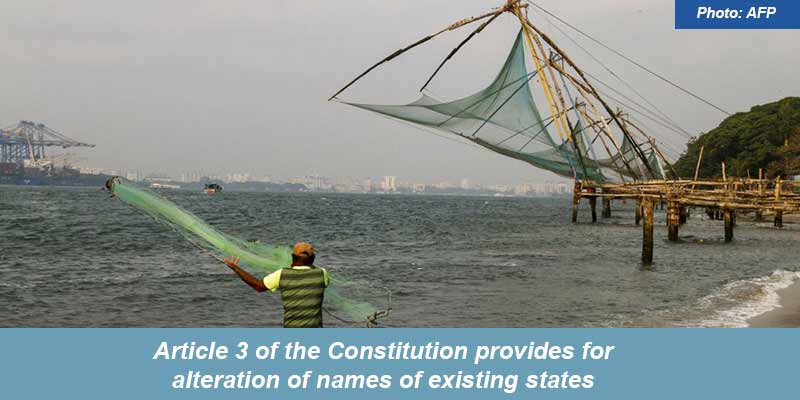
The Parliament passed the Kerala (Alteration of Name) Bill, 2026 to change the name of state of Kerala to Keralam on August 12.
Process for change of name to Keralam
• In August 2023 and June 2024, Kerala Legislative Assembly adopted resolutions urging the Centre to amend the First Schedule of the Constitution and rename the state as Keralam.
• Presenting the resolution, the then Chief Minister Pinarayi Vijayan said that the state was called ‘Keralam' in Malayalam, but in other languages it was still Kerala.
• The resolution urged the central government to make amendments necessary under Article 3 of the Constitution to change the state’s name to ‘Keralam’ in all languages included in the Eighth Schedule of the Constitution of India.
• Under the First Schedule of the Constitution, the state’s name was recorded as Kerala.
• Kerala Legislative Assembly passed the resolution for a second time after the Union Home Ministry suggested technical changes to the first proposal.
• The matter regarding alteration of the name of state of ‘Kerala’ as ‘Keralam’ was considered in the Ministry of Home Affairs.
• With the approval of Union Home Minister Amit Shah, the draft note for the Cabinet for the alteration of name was circulated to the Department of Legal Affairs and Legislative Department, Ministry of Law and Justice for their comments.
• The Department of Legal Affairs and Legislative Department, Ministry of Law and Justice concurred with the proposal for the alteration of the name of state of ‘Kerala’ as ‘Keralam’.
• The Union Cabinet approved the proposal for alteration of the name of state of ‘Kerala’ as ‘Keralam’ on February 24, 2026.
• President Droupadi Murmu referred the Bill to the Legislature of the state of Kerala for expressing its views thereon. The Legislative Assembly of Kerala adopted a unanimous Resolution agreeing with the Bill.
• The Kerala (Alteration of Name) Bill, 2026 provides for such alteration of name of the state of Kerala and contains necessary amendments to the provisions of the Constitution and also consequential provisions.
Article 3 and changing name of a state
• Article 3 of the Constitution deals with the formation of new states and alteration of areas, boundaries or names of existing states.
It states that:
Parliament may by law—
(a) form a new State by separation of territory from any State or by uniting two or more States or parts of States or by uniting any territory to a part of any State;
(b) increase the area of any State;
(c) diminish the area of any State;
(d) alter the boundaries of any State;
(e) alter the name of any State:
• However, a Bill to this effect can only be introduced in the Parliament on prior recommendation of the President. The President can only make such a recommendation after obtaining the views of the state legislature on the proposals in the Bill.
Names of states changed in the past
• In 2006, Centre approved changing Uttaranchal’s name to Uttarakhand.
• In 2011, Orissa’s name was changed to Odisha and the language became Odia from Oriya.
• In 1950, United Provinces was renamed as Uttar Pradesh. On January 24, 1950, the governor-general of India passed United Provinces (Alteration of Name) Order 1950, renaming United Provinces as Uttar Pradesh.
Request for renaming rejected by the Centre
• In July 2018, the West Bengal Assembly passed a resolution to change the name of the state to ‘Bangla’ in the three most-spoken languages — Bengali, Hindi and English — and had sent the proposal to the ministry of home affairs.
• It suggested ‘Paschimbanga’ in 2011, but it was turned down by the central government.
• In 2016, it proposed ‘Bengal’ in English, ‘Bangla’ in Bengali and ‘Bangal’ in Hindi, which was also turned down.
• When the earlier proposals were received, there was an objection from the central government that suggested the name ‘Bangla’ had similarity to Bangladesh and it would be difficult to differentiate the two at international forums.
(The author is a trainer for Civil Services aspirants.)