
- India
- Aug 18
- Sreesha V.M
Nepal President confers Honorary General rank on Indian Army chief
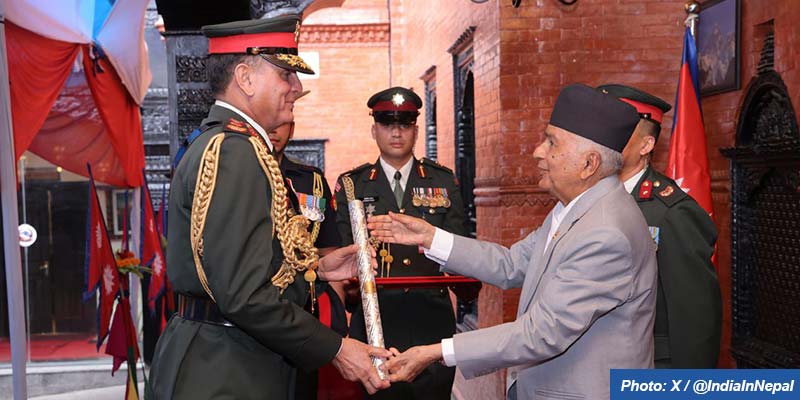
• Indian Army chief General Dhiraj Seth was conferred the rank of Honorary General of the Nepali Army by President Ramchandra Paudel during an investiture ceremony in Kathmandu on August 17.
• General Seth is on an official visit to Nepal from August 17 to 19 at the invitation of his Nepalese Army counterpart General Ashok Raj Sigdel.
• General Seth met General Sigdel at the Nepal Army headquarters.
• The two leaders discussed matters of mutual interest and ways to strengthen bilateral military relations.
• The conferment of the honorary rank is part of a unique and time-honoured military tradition under which India and Nepal reciprocally confer the honorary rank of General on the chiefs of each other’s armies.
• Commander-in-Chief General K.M. Cariappa was the first Indian Army chief to be decorated with the title in 1950.
• The tradition is more than a ceremonial honour and is an institutional expression of mutual trust, professional respect and military camaraderie between the two armies.
• Sustained across successive generations of military leadership, the ceremony therefore represents both tradition and strategic continuity.
• It underscores the commitment of the Indian Army and the Nepali Army to preserve their distinctive military relationship while strengthening cooperation in areas of mutual interest.
Defence cooperation between both countries
• The exchange of such high-level visits and continuation of tradition helps in strengthening relations between the two militaries and the two countries.
• The country shares a border of over 1,850 km with five Indian states — Sikkim, West Bengal, Bihar, Uttar Pradesh and Uttarakhand. Land-locked Nepal relies heavily on India for the transportation of goods and services.
• The India-Nepal Treaty of Peace and Friendship of 1950 forms the bedrock of the special relations that exist between India and Nepal. Nepalese citizens avail facilities and opportunities on par with Indian citizens in accordance with the provisions of the Treaty.
• Nearly 8 million Nepalese citizens live and work in India.
• India and Nepal have wide-ranging cooperation in the defence sector. India has been assisting the Nepal Army (NA) in its modernisation by supplying equipment and providing training.
• The ‘Indo-Nepal Battalion-level Joint Military Exercise Surya Kiran’ is conducted alternately in India and in Nepal.
• The Gorkha regiments of the Indian Army are raised partly by recruitment from hill districts of Nepal. Currently, about 32,000 Gorkha soldiers from Nepal are serving in the Indian Army.
• India and Nepal cooperate closely in areas such as countering narcotics, cross-border crimes, money laundering, etc, apart from strengthening interaction in training and capacity building in areas related to security matters.
• There are several bilateral mechanisms for discussing cooperation on security matters including border security.
• There is regular and mutually beneficial engagement between the law enforcement authorities of both sides on such issues.
• The signing of the agreement on Mutual Legal Assistance in Criminal Matters (MLAA) between India and Nepal in February 2026 will further enhance the effectiveness of investigation, prosecution and judicial proceedings in both countries for the prevention of cross-border crimes.
(The author is a trainer for Civil Services aspirants.)