
- India
- Aug 19
- Sreesha V.M
What is Miyawaki method?
• Under the Swachh Bharat Mission-Urban 2.0 (SBM-U 2.0), cities across India are undertaking the transformation of legacy dumpsites into productive and environmentally sustainable spaces.
• Raichur in Karnataka, has transformed the 35-acre Yakalaspura dumpsite into a green asset through scientific legacy waste remediation under SBM-U 2.0.
• About 62,252 million tonnes (MT) of legacy waste were scientifically processed and remediated.
• The project has led to the reclamation of nearly 22 acres of valuable urban land, significantly reducing environmental risks while improving the surrounding landscape.
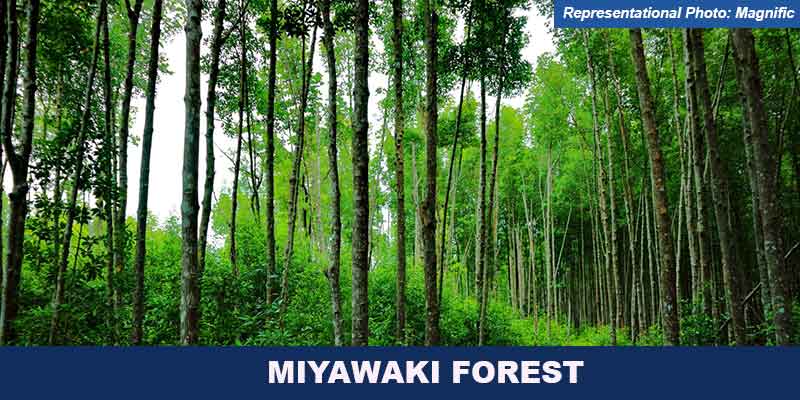
• The restored site now supports sustainable land use, including a vibrant Miyawaki forest, demonstrating how former dumpsites can be converted into thriving ecological spaces.
• Guided by the concept of ‘Toxic Waste to Ecological Wealth’, the city is developing a Miyawaki forest across approximately 5-7 acres of the remediated site in collaboration with Security Printing and Minting Corporation of India Limited (SPMCIL) and NewSpace India Limited (NSIL).
• A total of 60,000 saplings have been planted.
• It is expected that within one year, the area will be successfully afforested, resulting in the development of a green cover over the reclaimed land.
• The plantation includes bamboo and other native species that contribute to soil restoration, carbon sequestration, biodiversity enhancement, and improved air quality.
What is the Miyawaki method?
• Miyawaki is a method that has been named after Japanese botanist and ecologist Dr Akira Miyawaki, who devised it.
• Myawaki developed this technique in the early 1970s for the restoration of indigenous forests in Japan using native tree species.
• It is a technique to plant saplings of various species close to each other which develops into a dense urban forest. The growth of plants is ten times faster using this method and as a result, the forest developed is thirty times denser.
• Planting will be done densely where one square meter area accommodates at least four trees with different layers (1 canopy level, 1 tree level, 1 sub-tree level and 1 shrub level) for a multilayered forest.
• Through the Miyawaki method, a forest can be developed in just two to three years while it takes at least 20 to 30 years through the traditional method.
• Miyawaki forests absorb more carbon than conventional woodland schemes because they grow more quickly and are densely planted.
• Higher biodiversity has been recorded in Miyawaki forests than in neighbouring woodland.
• There is no doubt in the potential of Miyawaki crowd-foresting technique in the restoration of the lost tree cover in a short time in India.
• This technique is highly effective in the establishment of urban forests as well as converting unproductive wastelands into ecological and socially beneficial productive lands.
(The author is a trainer for Civil Services aspirants.)